How to Get Consulting Clients in 2026 (and Prove Results Under NDA)

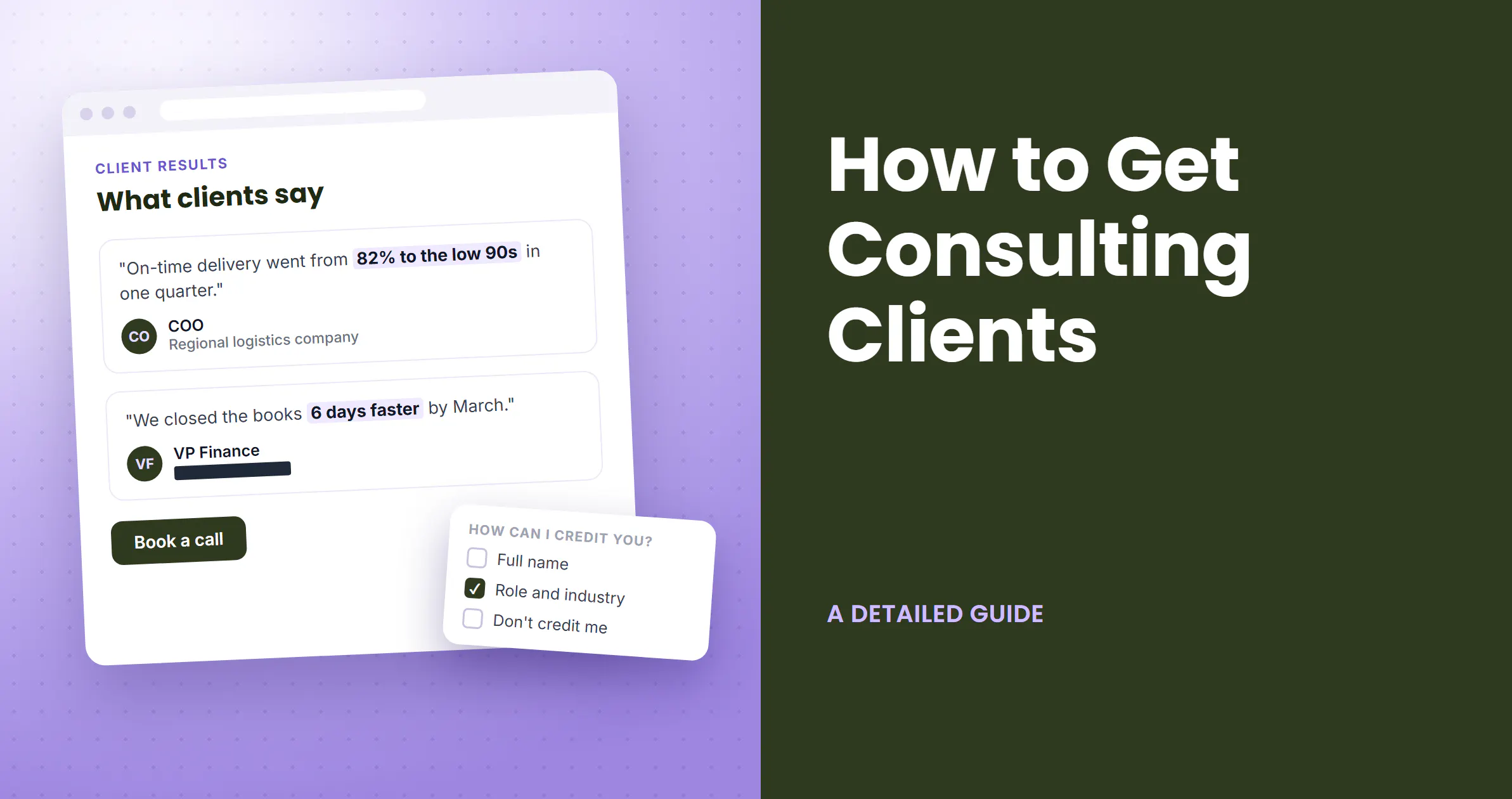
Your next consulting client will check you out first.
Maybe a past client sent them. Maybe they saw your LinkedIn post or got your email. Either way, they open your website and your profile before they reply.
If all they find is "client names confidential", the intro goes cold.
This guide covers how to get consulting clients from the channels that bring real work.
You'll also see how to set consulting rates and which AI tools for consultants save time. Then you'll see how to prove results when every client is under NDA.
For context, we build Famewall.
Consultants and advisory firms use it to collect client testimonials and show them on their own website. Most of the coaches and consultants who stopped using it had collected kind words and never put them on their site. So this guide spends real time on proof.
Here's the TLDR;
- For over half of consultants, 60% of their business comes from referrals. Start with people who already know your work.
- Ask for referrals at the end of a project, with a specific question and a note they can forward.
- Pick one buyer and one result. Specialists are far more likely to charge $10K+ per project.
- Set your rate from a salary, not a guess. A $101,860 salary works out to about $150 an hour.
- Every referral checks you out online. Put proof where they look.
- Under NDA, use role-and-industry testimonials, anonymised case studies and LinkedIn recommendations. Get the client's OK in writing.
- Use AI for research, call notes and first drafts. Never paste client names into it.
Start with one sentence that says who you help and what changes.
Nobody refers a job title.
"She's a strategy consultant" gives people nothing to repeat. "She fixes late deliveries for regional logistics companies" does. The second sentence is what a referral sounds like.
So write yours before you do anything else:
I help [type of company] [get a specific result] by [what you do].
Here are three made-up examples to show the shape:
- I help regional logistics companies cut late deliveries by fixing dispatch.
- I help accounting firms with 20 to 100 staff move clients to fixed fees.
- I help B2B software companies shorten their sales cycle with better discovery calls.
A narrow sentence feels risky. The data says it pays. In the Consulting Success fees study of nearly 1,000 consultants, 52% of specialists charge $10K or more per project. Only 18% of non-specialists do.

You can still take other work. The sentence just describes your ideal client, so people know who to send you.
Put it in your LinkedIn headline, at the top of your website and in your email signature.
Here are 9 ways to get consulting clients fast.
Start at the top of this list. Move down when the warm channels run dry.
Already busy and wondering how to get more consulting clients? Start with numbers 2 and 9.
| Channel | Best for | Your first step |
|---|---|---|
Your network | Your first clients | Message 50 people who know your work |
Client referrals | Steady work | Ask at the final readout |
Being checked out | Make your headline your one sentence | |
Targeted outreach | Gaps between referrals | List 50 companies with a trigger event |
Referral partners | Buyers other advisers see first | Call 3 firms that serve your buyer |
Speaking | Many buyers at once | Pitch one talk to an association |
Publishing | People who search your name | Answer one buyer question per article |
Platforms | First income and reviews | Set up one profile |
Past clients | Repeat work and retainers | Offer a 90-day check-in |
1. Tell 50 people who already know your work what you do now.
Your first clients are usually people who have watched you work.
List former bosses, colleagues, clients and vendors. Fifty names is plenty to start.
Then send each one a short personal note. Not a launch post and not a newsletter.
Hi Victor, I've gone independent. I now help [type of company] [get a result]. You saw me do this at [company] in [year]. Who's one person you know dealing with [problem] right now? I'd be glad to take a look for them, no pitch.
The question at the end matters. "Let me know if you hear of anything" gets a kind reply and nothing else. "Who's one person" makes them think of a name.
Then stay in touch every few months with something useful. A short note on a change in their industry is enough.
2. Ask for referrals at the moment a client is happiest.
Referrals are where most consulting work comes from. In the Consulting Success marketing study, over half of consultants get 60% of their business through referrals.
Most consultants wait for them instead of asking. Ask while the value is fresh. That's the final readout, the day a milestone lands or the moment a client says thanks.
Make the ask narrow:
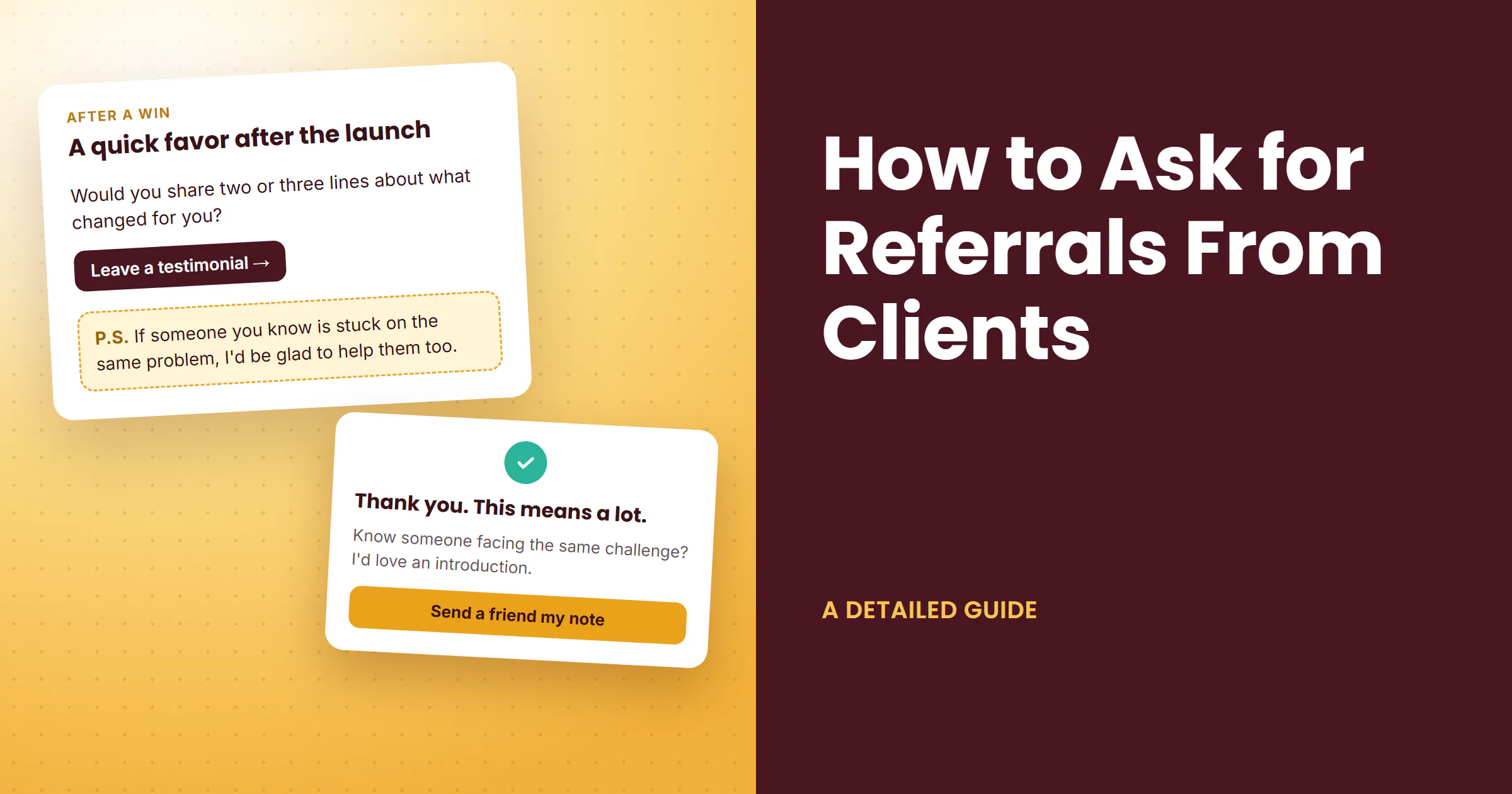
I'm glad this worked. Who else in your peer group is dealing with [problem]? If anyone comes to mind, I'll send you a short note you can forward.
Then send that note, so they don't have to write a thing:
[Your name] helps [type of company] [get a result]. [Your name] worked with us on [what you did] and we saw [result as a range]. Worth 20 minutes of your time: [booking link]
Here's the catch. The same study found that consultants earning $300K to $3M+ a year rely less on referrals. Referrals are your base. The channels below are how you grow past them.
The end of a project is also the best moment to ask for a testimonial. You'll see how to do that under NDA further down.
3. Make your LinkedIn profile answer the questions a referral is asking.
A referred buyer often opens your LinkedIn profile before your website. In the Hinge Research Institute's 2020 study of consulting buyers, more than 83% used LinkedIn.
Fix 3 parts first:
- Headline. Your one sentence, not your job title.
- Featured. One anonymised case study and a link to your client results page.
- Recommendations. Clients write these in public under their own names, which makes them hard to fake.

Asking a client for a LinkedIn recommendation takes one message. It's also a lower bar than a case study, because the client writes it and controls it.
Then post what you notice in your buyers' world. A short take on a new rule or a common mistake shows how you think.
4. Send targeted outreach to companies with a fresh trigger event.
Cold email and LinkedIn outreach work when they're timely and about them.
Look for trigger events. That's new funding, a new leader in your buyer's seat, an acquisition, a new regulation or a job post for the role you'd fill.
Build a list of 50 to 100 companies that fit your one sentence. Some people call it a Dream 100 list.
Then write each note yourself:
Hi [Name], congrats on [trigger event]. Teams in that spot often hit [problem] a few months in. I helped a [industry and size] company get [result as a range]. Would a 20-minute call on how they did it be useful?
Keep the volume small. Ten notes a week that you wrote yourself are plenty.
5. Partner with firms that already sell to your buyer.
Your buyer already pays other advisers. Accountants, law firms, agencies and software partners see their problems first.
Pick 3
firms whose clients need what you do and whose work you don't compete with. Tell them exactly who to send you and what you'll hand back.
Bigger consultancies also bring in specialists when a project needs a skill they don't have in-house. One good partner there can mean steady work.
6. Speak where your buyers already meet.
Industry associations, member webinars and niche podcasts all need speakers.
Pitch a talk about a problem your buyers have, not about your service. "What's really behind late deliveries at regional carriers" is an easier yes than "Our logistics consulting approach."
Offer the slides afterward to anyone who wants them. Then follow up with one useful idea, not a pitch.
7. Publish what you know so a search for your name finds something.
Writing rarely brings clients fast on its own. What it does is give a referred buyer something to read when they search your name.
Write one article for each question buyers ask you on discovery calls. A short monthly newsletter keeps you in front of past clients.
Keep it practical. A teardown of a public company's problem shows your thinking without touching client work.
8. Use platforms and expert networks to fill gaps, not to build a practice.
Marketplaces like Upwork, Catalant and Toptal can bring your first paid projects. Expert networks such as GLG and AlphaSights pay for short calls with investors and companies researching your industry.
They're useful for early income and early reviews. The trade-off is price pressure and a platform that owns the relationship.
Use them while your warm channels build up. Read each platform's terms before you work with a client outside it.
9. Go back to past clients before you chase new ones.
Your easiest next project usually comes from your last client.
Offer a 90-day check-in after every engagement. Look at what has changed and what comes next.
In the Consulting Success fees study, 41% of consultants want retainer clients but don't have them yet. A check-in is the natural place to offer a small ongoing role.
Every referral checks you out online before they call.
A referral gets you considered and doesn't get you hired.
The Hinge Research Institute surveyed 1,028 professional services buyers for its Beyond Referrals study. Over 80% visited the firm's website. Over 99% checked the firm out, using more than three methods on average.
That study is from 2014. Buyers have only gained more ways to check since then.
They're trying to answer 3 questions:
- Have you solved my problem before?
- For a company like mine?
- Can I believe it?

This is where consultants under NDA lose work. The website says "Fortune 500 clients" with no names, no quotes and no numbers. A prospect can't check any of it.
It matters in proposals too. Consulting Success found that nearly 70% of consultants win fewer than 60% of their proposals. Client words in a proposal give your buyer something to forward to the people who sign.
How to prove results when your clients are under NDA.
An NDA rarely means you can show nothing. It means you need to know what your contract covers and ask for the right thing.
Here are your options, from most specific to least:
| Proof you can show | What to ask the client |
|---|---|
A named quote with their name, title and company | Written OK to use their name |
A role-and-industry quote, like "COO, logistics company" | OK to credit them by role only |
An unnamed case study with results as ranges | A review of your draft |
A LinkedIn recommendation in their own words | A recommendation on LinkedIn |
Results across several clients | Check each contract first |
Sample work on a made-up company | Nothing, if it uses no client data |
Read the two clauses that decide what you can share.
Most client agreements limit two different things.
The confidentiality clause covers what you learned. That's their data, plans and numbers. The publicity clause covers whether you can name them at all or use their logo.
A Sprintlaw guide to client logos and case studies puts the risk plainly. A detailed case study "may breach the contract, even if the logo use itself was approved." Revenue growth and cost savings are on its list of risky details.
Some publicity clauses work both ways. Some need fresh consent for every use. So read yours before you ask for anything.
This isn't legal advice. If the wording is unclear, ask the client or a lawyer.
Ask for a role-and-industry testimonial when a client can't be named.
Plenty of clients who can't be named are fine being quoted by role. You just have to offer that option.
Would you share 2 or 3 sentences about what changed after our project? I'd credit you by role and industry only, like "COO, regional logistics company." No name and no company. I'll send you the final wording before it goes anywhere.
Ask about the before, what changed and one number if they'll give it. A range is fine.

Get the permission in writing. A reply to your email is enough to keep on file.
If you collect testimonials with Famewall, rename the form's Name field to "How should we credit you?" The client then types the credit they're happy with. Add a consent checkbox in your own words too.
Nothing reaches your site until you approve it. You can also edit the credit line later if the client changes their mind.
Write an anonymised case study with ranges instead of exact numbers.
A case study can tell the story without the name.
Describe the client by industry, size and region. Then write the problem, what you did and what changed. Give results as ranges or percentages.
In r/consulting threads on this problem, the common advice is to anonymise, generalise and aggregate. One example given is a "20 to 40% reduction in waste" instead of one exact figure.
Remove anything that points to one company. That means unusual products, exact headcounts, named executives and dates of public events.
For a fast first draft, our free AI case study generator asks you three questions: the challenge, your solution and the outcome. Here's what it wrote from a made-up logistics project:

It kept the client unnamed, because the inputs never named them. It also added details I never gave it, like the client "losing customer trust." Cut every line your client wouldn't recognise and keep the numbers.
Then send your edit to the client. Ask them to confirm that nothing in it identifies them.
Show results across several clients when one is too easy to spot.
Combined results hide any single client:
Across 9 supply-chain projects since 2022, on-time delivery rose between 6 and 14 points.
That one is made up to show the format. Use your own numbers.
Check each contract first, because some clauses restrict any use of a client's results.
Use the LinkedIn recommendations your clients already posted.
A LinkedIn recommendation is public, signed and written by the client. They chose to be seen.
Quote it on your site with a link back to LinkedIn, so anyone can check it's real. In Famewall you can add it by hand as a LinkedIn card, so it sits on the same wall as the rest.
Show how you think with a sample deliverable for a made-up company.
When you can't show any client work, show your method.
Rebuild a real deliverable for a fictional company. Use public data or invented numbers and label it clearly as a sample.
Never present it as client work. A buyer who finds out will assume the rest is made up too.
Put the proof where referred buyers look.
Proof in a folder wins nothing. Put it in three places:
- A client results page on your site, or a section on each service page.
- Your proposals, right next to the scope and price.
- Your LinkedIn Featured section.
If you offer more than one service, give each one its own proof. A buyer for supply-chain work wants to hear from operations leaders, not from a marketing client.

That's the setup Famewall is built for. Each service line gets its own collection link and its own client results page or embedded wall. Categories keep the testimonials sorted by service.
Jumpstart, a recruiting firm, runs separate walls for clients and candidates. Their walls get about 32,000 views a month.
You embed a wall once on Squarespace, WordPress or Webflow. After that, new testimonials show up as you approve them.
How to set consulting rates that attract the clients you want.
Your rate is part of how clients find you. It tells them who you're for before you say a word.
Most consultants no longer bill only by the hour. Here's how pricing breaks down in the Consulting Success fees study:
| Pricing model | Share of consultants | Works best when |
|---|---|---|
Project-based | 30% | The scope is clear |
Hourly | 29% | The scope is small or unclear |
Monthly retainer | 16% | The client wants ongoing access |
Value-based | 15% | You can tie the work to a result |
Daily rate | 10% | You run workshops or work on site |
Work out your hourly floor from a salary, then round up.
Every pricing model needs an hourly floor under it. Here's how to determine your hourly rate for consulting in four steps:
- Start with the salary for your role. The median US management analyst earned $101,860 in May 2025, according to the Bureau of Labor Statistics.
- Add what an employer would pay on top. Benefits were 30% of private employers' pay costs in June 2026, per BLS compensation data. So divide by 0.7 to get about $145,500.
- Divide by your billable hours. Twenty billable hours a week for 50 weeks is 1,000 hours, which gives $145.51 an hour.
- Round to the nearest $25. That's $150 an hour. Consulting Success suggests raising it after every successful project.

That $150 is a floor, not a target. It doesn't cover software, insurance or the slow months between projects.
$100 an hour is a fine start for consulting, but it caps your income.
Published consulting rates per hour vary a lot by field, so your own floor is a better anchor than an average.
$100 an hour is about double the $48.97 median for employed management analysts. For a new consultant that can be a fair start.
The problem is the ceiling. At 1,000 billable hours a year, $100 an hour is $100,000 before costs. That's about what a salaried analyst earns, without the benefits.
Move to project fees and retainers once you can scope the work.
Project fees reward you for working fast. Price them on the outcome, then check the hours behind them against your floor.
Retainers trade a fixed monthly fee for ongoing access. They smooth out your income between projects.
The same pricing models agencies use work for consultants, including retainers with a fixed scope.
These AI tools for consultants help most with getting clients.
Most lists of AI tools for consultants focus on slides and research. These five help with the work of getting clients.
Perplexity researches a prospect and shows its sources.
Ask it what changed at a target company this quarter. Its answers come with source links, so you can check a fact before you mention it in outreach. It has a free plan.
ChatGPT or Claude drafts your outreach, proposals and posts.
Both have free plans. Give them your notes and your one sentence, then rewrite the draft in your own voice.
Fathom records your calls so you keep a client's exact words.
Its free plan includes unlimited recordings and transcripts. Premium is $20 a month. Always tell clients when you record a call.

When a client says something kind on a call, you have their exact words. Send them back for approval and you have a testimonial.
LinkedIn Sales Navigator finds buyers and flags job changes.
Core costs $119.99 a month and comes with a free trial. Saved accounts and alerts tell you when a trigger event happens at a company on your list.
Famewall's AI case study generator turns three answers into a draft.
It's free and needs no login. You saw its output in the NDA section above.
One rule covers all five. Never paste client names, numbers or documents into an AI tool unless your contract allows it. Strip out anything that identifies the client first, and check the tool's data settings.
Copy these 5 ChatGPT prompts for consultants.
Find your positioning sentence:
Here are my last 5 projects, one line each, with no client names: [list]. Which problem shows up most often? Write 5 versions of "I help [who] [get result] by [how]". Keep each under 15 words.
Research trigger events (works best in Perplexity):
Find [industry] companies in [region] with 50 to 500 employees that announced [funding, a new COO, an acquisition] in the last 90 days. List the company, the news, the date and a source link.
Write a cold note:
Write a 90-word email to the [role] at [company]. Mention [specific observation]. Offer one idea about [problem]. End with a yes-or-no question. No buzzwords.
Write a referral note a client can forward:
Turn these notes into a 3-sentence intro a client can forward to a peer: who I help, the result I get and one anonymised example. Notes: [notes]
Clean up a case study for NDA work:
Rewrite this case study so no client can be identified. Describe the client by industry and size only. Turn exact numbers into ranges. Remove places, dates and product names. Then list anything that could still point to the client. [draft with names already removed]
Avoid these 5 mistakes that keep consultants waiting for work.
If you're wondering how to be a successful consultant, a steady pipeline is most of it. These five mistakes break it.
- Waiting for referrals instead of asking. Ask at the end of every project, with a specific question.
- Describing your title instead of your buyer's problem. People can't refer "strategy consultant." They can refer "fixes late deliveries."
- Claiming "Fortune 500 clients" with nothing to check. A role-and-industry quote with a range is easier to believe.
- Leaving testimonials in your inbox. It's the pattern we saw most among coaches and consultants who left Famewall. The proof was collected but never shown.
- Discounting to win the first client. Your first rate becomes your reference point. Start at your floor and raise it after each project.
How to get consulting clients: FAQs
How do I get my first consulting client?
Start with people who have seen your work. Message 50 former colleagues, bosses and clients with one sentence on who you help, and ask who they know with that problem. Ask each one for a name, not for work.
How much should a consultant charge per hour?
Start from the salary for your role, add about 43% for what an employer would pay in benefits and divide by your billable hours. For a $101,860 salary at 1,000 billable hours, that's about $150 an hour. Treat it as a floor and raise it after each successful project.
Can I use a client testimonial if I signed an NDA?
Often yes, with the client's written permission and the right level of detail. Read your confidentiality and publicity clauses, then offer to credit the client by role and industry only and to share ranges instead of exact numbers. If the contract is unclear, ask the client or a lawyer.
Do I need a website to get consulting clients?
You can land your first clients without one, but referred buyers will look you up. One page with your positioning sentence, a few testimonials and a way to book a call covers what they check. Your LinkedIn profile can do that job until then.
What is the best AI tool for consultants?
It depends on the job. Perplexity is strong for prospect research with sources, Fathom for call notes and ChatGPT or Claude for first drafts. For case studies, Famewall's free AI case study generator turns your challenge, solution and outcome into a draft.
Show proof without naming your clients
Famewall gives each service line its own collection link and its own wall. Clients answer in text or on video, you approve every word before it goes live and the wall sits on your own website.