How to Ask for Referrals From Clients: Scripts, Email Templates and a Testimonial in the Same Message (2026)

One MSP offered clients $500 for every referral.
Nothing came of it.
Clients still referred people, but nobody cared about the reward.
One told the owner they didn't want the money. The relationship risk of "you making them look bad far outweighs any tacky $500 bonus."
That's the part most advice on how to ask for referrals misses.
A referral is a client lending you their name.
They'll do it gladly when the ask is easy and the risk is small. This guide shows you how to make both true.
You'll get the moments to ask, who to ask and the exact words to use. There are email, text, in-person and LinkedIn scripts you can copy.
The examples are written for firms that sell expertise and coaches who run programs.
And it covers the move I'd make first. Ask for a testimonial and a referral in the same message.
For context, we build Famewall, a testimonial tool.
1 out 3 coaches who pay for it arrived because someone recommended it. So I've watched word of mouth work from the receiving end.
Here's the TLDR;
| Step | Do this |
|---|---|
1. Pick the moment | Within a week of a win, like the day a migration goes live |
2. Pick the client | Someone who'd score you 9 or 10 out of 10 |
3. Ask for a testimonial | Send one link: "Could you share what changed?" |
4. Ask for the referral | Name one type of person: "Who else is stuck on [problem]?" |
5. Make it easy | Give them three sentences they can forward |
6. Close the loop | Thank them and tell them what happened |
Step 3 is the one most guides skip. It's also the one that makes steps 4 and 5 easier.
Ask for the testimonial first and the referral second, in one message.
Most advice treats these as 2 separate favors. I think that's a mistake.
When a client writes a testimonial, they put into words what you did for them.
That's the same sentence they'd use to recommend you. So the testimonial does half the referral's work before you mention a referral.
It helps for four reasons.
The testimonial gives your client the words.
Plenty of clients would happily refer you. Many just can't describe what you do.
"She's a great accountant" gives a friend nothing to act on.
"She cleaned up two years of messy books before our bank loan" does.
A good testimonial question pulls out the second sentence. Ask what changed and what they'd tell someone in their old position. Those are the testimonial questions to ask your clients that produce a referral-ready answer.
The referred friend checks you out, and the testimonial is what they find.
A referral gets you considered. It doesn't get you hired.
The Hinge Research Institute surveyed 1,028 professional services buyers for its Beyond Referrals study. Over 80% visited a firm's website while checking it out.
What they find there either backs your client up or leaves them exposed. A page of real client stories means your client isn't vouching alone.
That's the risk the MSP owner was talking about.
Recommending you makes your client more loyal.
This one surprised me.
4 marketing researchers studied the customers of a global mobile carrier.
In a field experiment, customers who recommended the company saw their defection rate fall from 19% to 7% within a year.
Their monthly revenue grew 11.4% against a matched control group.
The effect was strongest with newer customers. The study is by Garnefeld, Eggert, Helm and Tax in the Journal of Marketing (2013).
The researchers credit "the loyalty effect of voicing a recommendation."
A testimonial is a recommendation said out loud too. I can't promise those exact numbers for a coaching client or an IT client.
But asking a client why they chose you doesn't cost the relationship anything.
The testimonial is the only real ask.
The obvious pushback is that two asks in one message feel greedy. Some guides say to keep them apart.
That's fair when both asks are big. So don't make them equal. The testimonial is the request. The referral is one optional line after it, and it never needs a reply.
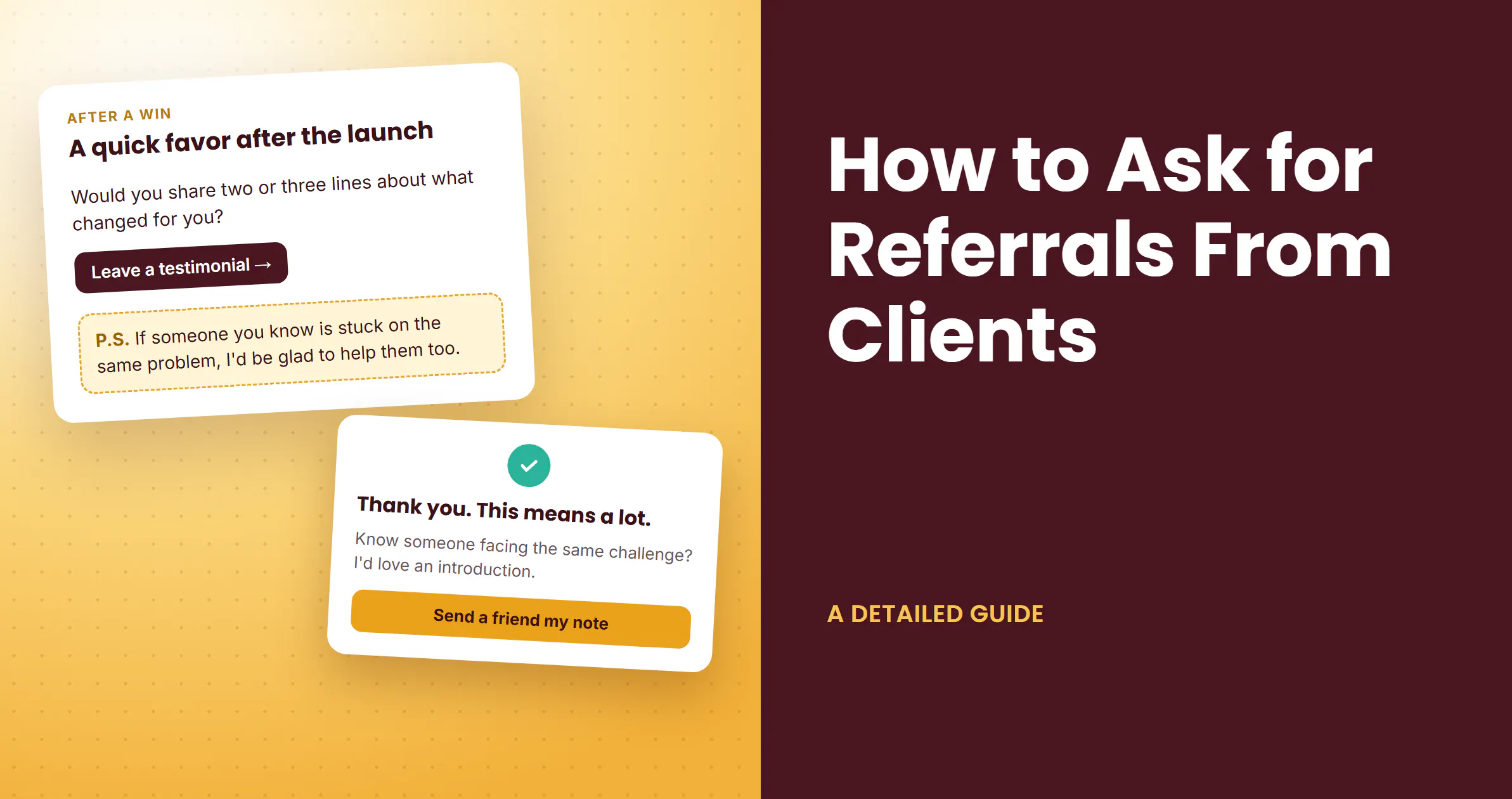
Here's the two-ask message I'd send after a win:
Subject: A quick favor after [the win] Hi [Name], [The win] went live this week. Thank you for trusting us with it. Would you share two or three lines about what changed for you? It takes about two minutes here: [testimonial link] P.S. If someone you know is dealing with [specific problem], I'd be glad to help them too. No need to reply if nobody comes to mind.

The P.S. keeps the referral light.
The main body asks for something small and specific, and the last line takes the pressure off. For more wording on the testimonial half, there's a testimonial request template with variations.
Ask within a week of a win, not when the invoice goes out.
The right moment is when the client can feel what you did for them. That feeling fades fast.
For firms, a win is usually an event you can put in a calendar:
- An MSP finishes a migration, handles a security incident or shows fewer tickets at a quarterly business review.
- An accountant files the return early, closes an audit or makes a penalty notice go away.
- A financial adviser finishes the annual review or a plan milestone lands.
- A recruiter's placement passes probation.
- A consultancy or agency presents a result the client can repeat to their boss.
For coaches, the moments come from the program:
- The last session of a 1:1 program or the final call of a cohort.
- A breakthrough session, when the client says "this changed how I see it."
- A renewal, because they just chose you again.
- Any time a client mentions a friend who is stuck on the same thing.

There's one more moment that works for everyone. It's when a client thanks you without being asked. Reply to that thank-you with your testimonial link and the referral line.
Avoid 2 moments. Don't ask in the middle of a messy project. And don't put the ask in the same email as an invoice.
You can plant the seed much earlier. Tell new clients at kickoff that most of your work comes from referrals.
It's one line in your client onboarding checklist, and it makes the later ask feel expected. The testimonial side has its own timing rules too. How long to wait before asking for a testimonial depends on how fast your clients see results.
Ask the clients who would score you a 9 or 10, one at a time.
A referral ask isn't a newsletter. Send it to one person, by name, about one win.
The best list is the clients who would score you 9 or 10 out of 10. If you collect testimonials, the list is even easier to build. The clients who just wrote you a glowing one are on it.
One at a time sounds slow. It's worth it.
3 researchers followed about 10,000 customers of a German bank for almost 3 years.
Referred customers were worth at least 16% more than similar customers who came in another way. They were also about 18% less likely to leave at any point.
Describe one specific person instead of "anyone who needs help."
"Let me know if you know anyone" is the most common referral ask. It almost never works.
It asks your client to search their whole memory for a match.
Most people find nothing and move on. A specific ask does the search for them. Name the situation and the trigger, and one face comes to mind.
Here's what a specific ask sounds like in each field:
- MSP: "Who do you know running a 20-person office on an old server in a closet?"
- Accountant: "Who in your network just started paying themselves a salary from their company?"
- Financial adviser: "Who do you know who's planning to sell their business in the next two years?"
- Consultant: "Which of your peers is fighting late deliveries this quarter?"
- Recruiter: "Which founder do you know who's hiring their first salesperson?"
- Coach: "Who's stepping into their first leadership role this year?"

When a client gives you a name, ask one more question. "What made you think of them?" The answer tells you how to open the first conversation.
Give your client a note they can forward in ten seconds.
Even a willing client stalls at a blank email. So write it for them.
Keep it to three sentences in their voice, with one link:
Hi [Friend], I worked with [Your name] on [what you did together]. [One result, in plain words]. You mentioned [their problem], so I thought you two should talk: [booking link]
Send it as plain text so they can paste it anywhere. Email, Slack and WhatsApp all take it.
Two rules keep this safe for your client.
Let them make the introduction. Don't email a name they gave you out of the blue. Ask your client to check with their friend first, or to copy you in once the friend says yes.
Never pass on anything confidential. The note describes your client's experience in their own words. You don't add details they didn't choose to share.
For clients who live on WhatsApp, there's a shortcut.
A link that starts with https://wa.me/?text= followed by your note opens WhatsApp with the note already typed.
Your client picks a contact and taps send. It's documented on WhatsApp's click to chat page. Run the note through any free URL encoder first so the spaces become %20.
Copy these referral email templates and scripts.
Each template below is short on purpose.
That's most of how to write a referral request: one result, one person and one easy next step.
Swap the brackets and keep the length. If you also want more wording for the testimonial half, there are more testimonial request email templates to pick from.
Referral request email to a past client
Subject: Thinking of you Hi [Name], It's been [time] since we [finished the project]. I hope [the result] is still holding up. I'm taking on a few more [type of client] this [quarter]. If you know someone dealing with [specific problem], I'd be grateful for an introduction. I'm happy to send a short note you can forward. Either way, it was a pleasure working with you.
Reply to a client who just thanked you
That made my week. Thank you. Would you mind putting that into a couple of lines here? [testimonial link] And if anyone you know is facing [problem], send them my way. I'll take good care of them.
Text or WhatsApp message
Hi [Name], so glad [the win] worked out. Small favor: if you know anyone who's [specific situation], I'd love an intro. Here's a note you can forward if that's easier: [link]. No worries if nobody comes to mind!
What to say on a call or in person
"I'm really glad [result] worked. Most of my clients come from people like you. Who else do you know who's [specific situation]?" If they name someone: "What made you think of them?" Then: "Would you be comfortable introducing us? I'll send you a short note so you don't have to write anything."
LinkedIn message to a client
Hi [Name], thanks again for [project]. I'm looking to help a few more [role] with [problem] this quarter. Does anyone in your network come to mind? If so, I'll send a two-line intro you can forward.
LinkedIn works the other way too. A written recommendation on your profile is proof the next referral can read. Here's how to request a recommendation on LinkedIn without making it awkward.
Email signature and P.S. lines
Most of my clients come from introductions. If you know someone dealing with [problem], I'd love to meet them. P.S. Know someone stuck on [problem]? Forward them this email.
Client referral card wording
Some firms and coaches hand over a printed card at the last session or mail one with a thank-you note. Keep the wording personal and short:
Front: Thank you for trusting me with [the work]. Back: If someone you care about is facing [problem], I'd be honored to help them too. [Your name] · [phone] · [booking link or QR code]
Follow-up when they haven't replied
Follow up once, about a week later. Then stop.
Hi [Name], just floating this back up in case it got buried. No pressure at all on the intro. And if you have two minutes for the testimonial, here's the link again: [testimonial link]
Thank-you note after a referral
Hi [Name], Thank you for introducing me to [Friend]. We spoke on [day] and [one honest line about how it went]. I'll take good care of them. I really appreciate you thinking of me.
The thank-you note is the template that earns the next referral. People keep referring when they hear what happened.
Put the referral line on the screen clients see after they leave a testimonial.
Every form has a thank-you screen. Most say "Thanks for your submission" and nothing else.
That screen appears the moment your client has finished writing why you're good at what you do. It's the warmest moment in the whole relationship, and most people waste it.
Here's what to put there instead:
- A real thank-you, in your voice.
- One sentence about who you'd love to help next.
- One button that opens a ready-made note they can send a friend.
I'll show it in Famewall, because it's the tool I built and know best.
Google Forms and Typeform let you edit their thank-you screens too, so the same idea works there.
Set up the referral line in 5 steps.
- Open your collection page in the dashboard and expand the Thank you Popup panel.
- Write a title that thanks them, such as "Thank you. This means a lot."
- Add one line to the Thank You Message about who you'd love to meet next.
- Turn on Enable Custom Call To Action and give the button a short label.
- Paste a link as the Call To Action URL, such as a wa.me link with your note or your booking page.

The button needs a web link that starts with https. If you'd rather use email, put a mailto link inside the message text instead. The message supports Markdown, so it can hold links.
On a paid plan (from $15 a month) you can also upload a thank-you video.
30 seconds of you saying thanks, with the referral line at the end, feels personal in a way text can't.
Add one optional question to the testimonial form.
You can also ask inside the form itself. Add a custom field with a question like "Who's one person facing the same challenge?" and mark it as optional in the label.

Clients can skip the field. The answers show up next to the testimonial in your dashboard and never appear on your public wall.
Ask for a first name only.
Then go back to your client and ask them to make the introduction. A name on a form is permission to ask your client, not permission to contact their friend.
Famewall won't send the request emails for you. You send the testimonial collection link from your own email or WhatsApp. I think that's right for referrals anyway. The ask should come from you.
Skip the cash bounty and thank people instead.
Most client referral program ideas you'll find online start with a reward. For firms and coaches it often backfires.
The MSP owner from the start of this post is one example.
Money changes what a referral is. Your client stops sounding like a fan and starts sounding like an affiliate. People can tell.
Here's what works better, from smallest to biggest:
- A handwritten note.
- An update on how it went, with the friend's okay.
- Lunch or coffee.
- A donation to a charity they care about.
- A book you think they'd enjoy.

Give it after the referral, as a surprise. A thank-you that wasn't promised can't feel like a payment.
Check your profession's rule before you offer anything.
Some professions limit what you can give for a referral. Here's where the main ones stand:
| Who | The rule and what it means |
|---|---|
Lawyers (US) | ABA Model Rule 7.2(b): nominal thank-you gifts only, nothing that works as payment. |
Investment advisers (US) | SEC Marketing Rule: a paid client referral needs disclosures, and over $1,000 a year also needs a written agreement. |
ICF coaches | ICF Code of Ethics 3.8: tell clients about referral fees or benefits you pay or receive. |
Anyone praised in public | FTC Endorsement Guides: a rewarded referrer must disclose the reward when they post about you. |
Accountants, insurance, real estate | Your licensing board: many limit or ban referral fees, so check before you offer one. |
The texts are short and worth reading: ABA Model Rule 7.2, the SEC Marketing Rule, the ICF Code of Ethics and the FTC Endorsement Guides. State rules can be stricter than the model rules.
Run a simple client referral program in 30 minutes a month.
A client referral program doesn't need software. For a firm or a coach it's four things.
- A short list. The clients who would score you 9 or 10, plus the partners who send you work.
- A calendar of moments. QBRs, renewals, filing deadlines and cohort end dates, each with a reminder.
- Two templates. The two-ask message and the thank-you note from this post.
- A tracker. One row per ask, so nobody gets asked twice in a month.

Once a month, open the tracker and ask two questions.
Who had a win this month? And who referred someone without hearing what happened?
For consultants this is most of the pipeline. In the Consulting Success marketing study, over half of consultants get 60% of their business via referral.
Referrals are the base, and the other channels for getting consulting clients are how you grow past them.
Referrals are also one part of a wider customer advocacy program. For most firms and coaches, they're the part that pays first.
Make your website ready for the friend who checks you out.
Every referral ends on your website. So the last part of the program is what they find there.
Proof works best when it matches what the friend came for.
If you run several programs or service lines, give each one its own testimonials on its own page. Collaborate Sports does this for its coaching mentorships.
The 1-to-1 mentorship page and the soft skills cohort page each show testimonials from that program.

Firms can do the same per service line.
An MSP can put client stories on each service page, so a referred prospect who needs cybersecurity reads cybersecurity clients.
Jumpstart, a recruiting firm, keeps separate walls for clients and candidates, and they get about 32,000 views a month. If you only have one page, make it a client results page with every story on it.
Your client vouched for you. Your website should back them up.
Avoid these 7 mistakes when you ask for referrals.
- Sending one email to your whole list. A mass ask reads like a newsletter. Ask one person about one win.
- Saying "let me know if you know anyone." It's too vague to act on. Name the situation.
- Asking before you know they're happy. If you're unsure, send the testimonial link alone. Let the thank-you screen carry the referral line.
- Paying cash or discounting an open invoice. It turns a fan into an affiliate.
- Contacting a name cold. Let your client make the introduction.
- Chasing more than once. One follow-up, then stop.
- Never reporting back. Tell the referrer what happened. It's the reason they'll do it again.
How to ask for referrals: FAQs
How do you politely ask a client for a referral?
Ask right after a win, by name, and describe one specific type of person you can help. Give them a short note they can forward and an easy way to say no. A line like "no need to reply if nobody comes to mind" does that.
Is it okay to ask for a testimonial and a referral in the same message?
Yes, as long as the testimonial is the main ask and the referral is one optional line after it. Writing the testimonial puts your value into words, which makes the referral easier. You can also put the referral line on the thank-you screen clients see after they submit.
Should you pay clients for referrals?
Usually not. Cash and invoice discounts can make a referral feel like a sales pitch, and a surprise thank-you afterwards works better. Lawyers, investment advisers, ICF coaches and other licensed professionals also have rules on referral rewards, so check yours first.
How do you ask coaching clients for referrals when sessions are confidential?
Never share anything from your sessions. Ask at the end of the program and let the client decide what to tell their friend. Give them a note about their experience in their own words, and let them make the introduction.
What should a referral request email say?
Thank the client for one specific result. Then describe the kind of person you'd like to help and the problem they have. Offer a short note they can forward, and make it clear there's no pressure to reply.
Collect the testimonial and the referral with one link
Famewall gives each program or service line its own collection link. Clients answer in text or on video, and the thank-you screen carries your referral line with a button that opens a note they can send a friend.