Donor Stewardship: How to Build a Plan That Earns the Second Gift (2026)

Most first-time donors never give a second gift.
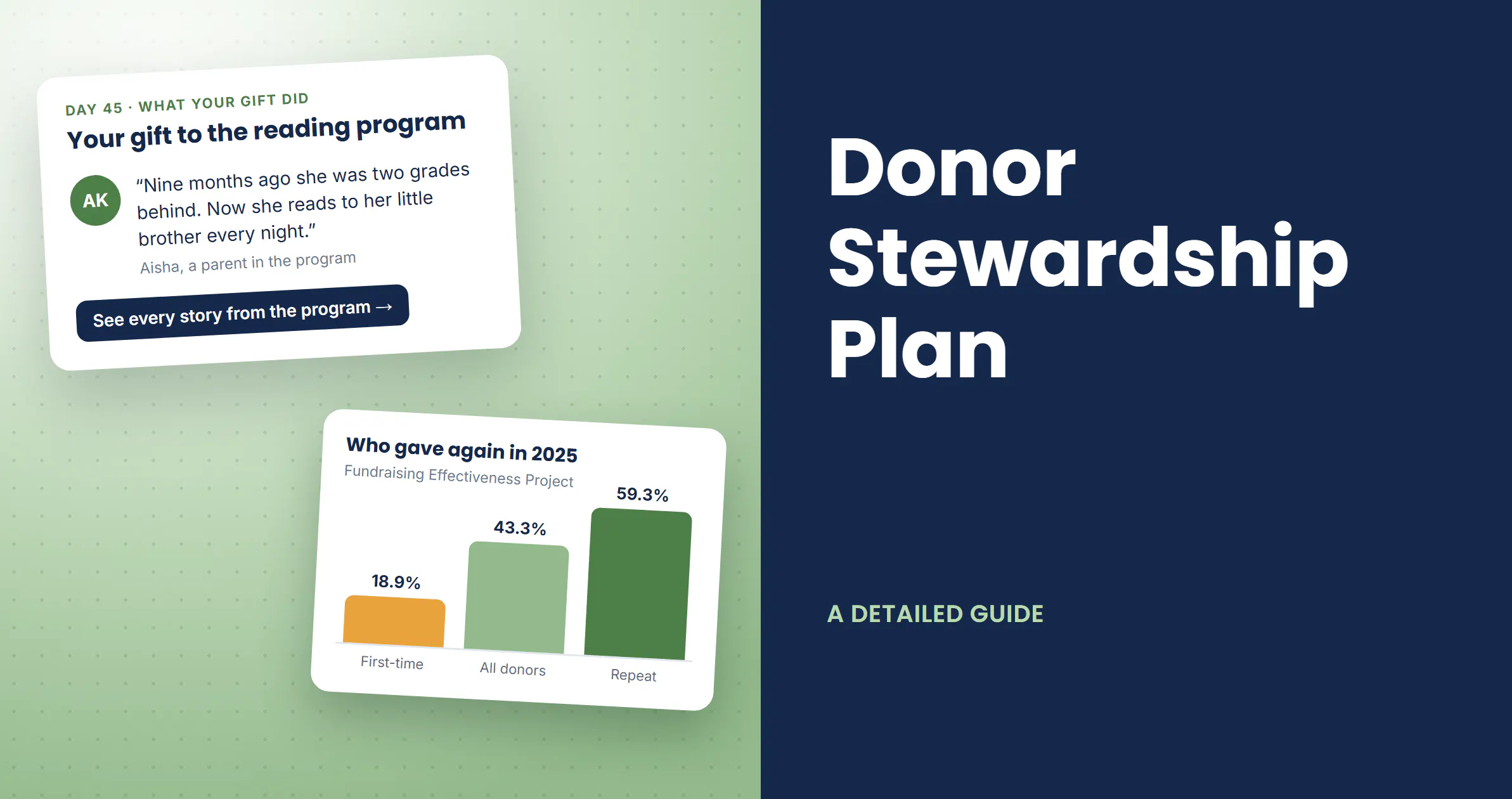
In 2025, only 18.9% of first-time donors gave again the next year.
Donors who had already given twice were a different story. 59.3% of them gave again.
So the whole job of donor stewardship fits in one line. Get the second gift.
This guide shows you how to do that with a plan that fits on one page.
You'll get the 2026 retention benchmarks and a calculator for your own numbers. Then a stewardship matrix for each donor group and a first-90-days plan for new donors.
For context, we build Famewall. Associations and nonprofits like AAHA and WKAR use it to collect stories from members and supporters and put them on their own websites.
Here's the TLDR;
- Donor stewardship is everything you do after a gift so the donor gives again.
- The average donor retention rate was 43.3% in 2025. First-time donors were 18.9%, and repeat donors were 59.3%.
- Donor retention rate = donors from last year who gave again this year ÷ all donors from last year × 100.
- Build the plan as a matrix. Each donor group gets 4 touches: thank, show, recognize and listen.
- The first 90 days decide whether a first-time donor gives again.
- A thank-you call alone doesn't move retention. In a study of 500,000 new donors, calls made no difference.
- What does work is showing donors what their gift did. Program stories do that, and so do stories from other donors about why they give.
What is donor stewardship? It's everything you do after the gift.
Donor stewardship is how you treat a donor between one gift and the next. You thank them, show them what their money did, recognize them and keep them close to the work.
Cultivation is what happens before the first gift. Stewardship is what happens after it, and it's what earns the next one.
Kathleen Kelly, the scholar who put stewardship into the public relations process, boiled it down to 4 parts.
- Reciprocity. You show gratitude for the gift.
- Responsibility. You use the money the way you said you would.
- Reporting. You tell the donor what happened.
- Relationship nurturing. You keep the donor involved between asks.
A donor stewardship plan is the written version. It says which donors get which touches, when they get them and who sends them.
It doesn't need to be a 30-page binder. For most nonprofits, it fits on one page.
What is a good donor retention rate? Above 43% overall, and above 19% for first-time donors.
The Fundraising Effectiveness Project (FEP) is the closest thing the sector has to a national benchmark.
It's run by the AFP Foundation for Philanthropy and GivingTuesday, with data from Bloomerang, Neon One, DonorPerfect and other donor databases.
Its Q4 2025 report covers the full year. Here's how often each group of donors gave again in 2025.
| Donor group | Gave again the next year |
|---|---|
All donors | 43.3% (FEP, 2025) |
First-time donors | 18.9% (FEP, 2025) |
Repeat donors | 59.3% (FEP, 2025) |
Gave once last year | 31.9% (FEP, 2025) |
Gave 7+ times last year | 87.4% (FEP, 2025) |
New online donors | 24% (M+R, 2025) |
Monthly donors | 71% still giving after 12 months (M+R) |
The pattern is the point. Each extra gift makes the next one far more likely.

Donors who gave once last year came back 31.9% of the time. Donors who gave 7 or more times came back 87.4% of the time.
The FEP's summary calls turning a first gift into a second "the most consequential unsolved problem in the donor pipeline." The rate for first-time donors didn't move at all between 2024 and 2025.
Why the average donor retention rate you read online keeps changing.
Search for the national average donor retention rate and you'll see numbers anywhere from 26% to 55%.
They're all real. They just measure different things.
- Full year vs year to date. The FEP's Q2 2026 report shows 26.4%, but that's only January to June. Donors still have half a year left to give.
- Online only. M+R Benchmarks 2026 found 48% of online one-time donors gave online again. It doesn't see checks or event gifts.
- One vendor's customers. Some donor database companies publish the average for their own clients. That's useful, but it isn't the sector.
- Monthly donors. They're measured month by month. M+R found 71% of monthly donors were still giving after a year.
So compare like with like. Use the full-year FEP numbers for your whole file, and track first-time and repeat donors as 2 separate lines.
A good donor retention rate is one that beats your own number from last year. The averages tell you where you stand. Your own trend tells you whether the plan is working.
How to calculate donor retention rate in 2 minutes.
Here's the donor retention formula.
Donor retention rate = (donors from last year who gave again this year ÷ all donors from last year) × 100
Say 500 people gave last year and 215 of them gave again this year. 215 ÷ 500 × 100 = 43%.

Then run the same math twice more, because one number hides the problem.
- First-time donor retention. Take last year's first-time donors and count how many gave again.
- Repeat donor retention. Do the same for everyone else from last year.
A few rules keep the numbers honest. Count people, not gifts. Use the same 12 months in both years, like January to December. Count a household once.
Type your own numbers in below. The calculator compares each rate with the FEP's 2025 averages.
Donor retention rate calculator
Count unique donors, not gifts, for the same 12 months in both years. The example numbers are there so you can see how it works.
Optional. Splits your rate into first-time and repeat donors.
Optional.
Optional. Total gifts last year divided by donors.
All donors
43.0%
0.3 points below the 43.3% average
First-time donors
19.0%
0.1 points above the 18.9% average
Repeat donors
59.0%
0.3 points below the 59.3% average
285 of last year's 500 donors haven't given again, about $42,750 a year at your average gift.
Lifting your first-time donor rate by 10 points keeps 20 more donors (about $3,000 a year). That group is where a stewardship plan pays first.
Averages: the Fundraising Effectiveness Project's Q4 2025 report (full-year 2025 data from 15,102 nonprofits).
If your first-time rate is the weakest of the 3, you're in good company. That's where a stewardship plan pays back first.
Why a thank-you alone won't keep donors, and what will.
Every guide on donor stewardship says to thank donors fast. You should, because the receipt is the first touch a donor gets from you.
In the US, a donor who gives $250 or more needs a written acknowledgment from you to claim the deduction.
The IRS rules also ask for a disclosure on any gift over $75 where the donor got something back, like a gala ticket.
But here's what most stewardship plans miss. The thank-you is manners. It isn't the plan.
Anya Samek and Chuck Longfield tested this at scale. They randomly picked 500,000 new donors at public TV stations and a national nonprofit, then thanked half of them with a phone call.
Fundraising professionals predicted the calls would raise retention by about 80%. The calls made no measurable difference.
That doesn't mean you should stop calling. It means the call can't carry the plan on its own.
The FEP's advice for first-year donors points at what's missing. Show the impact clearly and promptly after the first gift.
In other words, stewardship means showing donors what their gift did. A receipt says thank you. A story from the program tells them their money landed somewhere real.
Here's how to build a donor stewardship plan in 6 steps.
You can do this in an afternoon with last year's donor list and a spreadsheet.
- Pull last year's numbers. Work out your overall, first-time and repeat retention rates with the calculator above, so you have a baseline.
- Split donors into 5 groups. Use first-time, repeat, monthly, mid-level and major, and lapsed donors.
- Give every group 4 touches. Each group gets a thank-you, a "here's what your gift did" update, some recognition and one question.
- Put the touches on a calendar. Start with the first 90 days for new donors, then fill the rest of the year.
- Collect the stories before you need them. Ask each program for a few stories, and ask donors why they give.
- Name an owner for every row and review it every quarter. Check the plan against your retention rates, and cut what nobody sends.
Split donors by how they give, not only by how much.
Gift size still matters for major donors. But for most of your file, how long someone has given tells you more than how much.
A $50 donor in their fifth year needs a different note than a $50 donor in their first week. Your donor database can split them by first gift date and number of gifts.
Give every group 4 touches in a donor stewardship matrix.
A donor stewardship matrix is a grid. Donor groups go down the side, and the touches go across.
Keep it to 4 touches per group to start. You can add more once these run on time.
| Donor group | Thank, show, recognize, listen |
|---|---|
First-time donors | Thank in 48 hours. Program story in week 2. What your gift did at day 45. Ask why they gave at day 60. |
Repeat donors | Thank with their giving history. A story from their program every quarter. A "why I give" feature, with permission. A yearly survey. |
Monthly donors | Welcome in week 1. What 12 gifts added up to at year one. An anniversary note. Ask how they'd like to hear from you. |
Mid-level and major donors | A personal call or note. A report on their program. A tour or a field visit. A real conversation about what's next. |
Lapsed donors | Thank them for past support. One story from the program they funded. Invite them back without guilt. A 3-question survey. |
Notice the second touch in every row. It's a story or a result, instead of another ask.
Members and volunteers who also give belong in the matrix too. Their recognition can be a member spotlight or a volunteer story on the site.
Run the donor stewardship cycle all year, not once a year.
The donor stewardship cycle is simple. Thank, show, recognize, listen and then ask again.

The ask comes last, and it should sound like the donor's own reason for giving. That's only possible if step 4 happened.
The first 90 days decide whether a first-time donor gives again.
If you only fix one part of your stewardship plan, fix this one. It's the group with the 18.9% rate, and it's the one the FEP says the sector hasn't cracked.
Here's a first-90-days plan you can copy.

- Within 48 hours. Send the receipt and a short personal thank-you. Name the program they gave to.
- Week 2. Send a welcome note with one story from that program, in the words of someone it helped.
- Day 45. Send a "here's what your gift did" update. Make it a person, a number and a photo, instead of a newsletter.
- Day 60. Ask one question. "What made you give?" Their answer tells you what to say next time.
- Day 90. Invite them in. Think a tour, a volunteer shift, a short video from the field or an event.
Then let them hear about their program again at month 6. Make the renewal ask around month 10 or 11, using the reason they gave you on day 60.
For most nonprofits, that renewal ask is the year-end appeal letter. Open it with the story of the program they funded.
Monthly donors need a version of this too. M+R found 10% of new monthly donors stop within 2 months, so their welcome matters even more.
Show donors what their gift did. Here are 3 real examples.
The best donor stewardship examples don't look like fundraising. They look like proof.
DonorsChoose sends every donor a thank-you package from the classroom.
On DonorsChoose, teachers ask the public to fund classroom projects. When a project is funded, the teacher owes donors a thank-you package.

Per the DonorsChoose help center, it includes an impact letter from the teacher.
It also has 2 to 10 photos of the students using what donors paid for, and for some projects, handwritten thank-yous from the students.
What you can learn from this:
Make the thank-you itself the impact report. A photo of the thing their gift bought beats any "your support makes a difference" line.
charity: water gives every finished project its own page.
charity: water publishes a page for each completed water project. This one, for Bihanga II in Uganda, shows the map coordinates, photos of the tap stand and the local partner.

It also says how many people the project serves, which is 22. Each fundraising team's page lists the projects its money funded.
What you can learn from this:
Give each donor's money a place they can picture. You don't need GPS for that. A program page with real faces and one honest number does the job.
WKAR asks its supporters to share their own story.
WKAR Public Media, the public radio and TV station at Michigan State University, has a Share Your WKAR Story page.
Supporters can send in text, record a video or audio clip, or call and leave a voice message.

WKAR uses those stories to show decision makers how much the community values the station. Listeners and viewers write them in their own words.
What you can learn from this:
Your donors' reasons for giving are stewardship too. When you ask why they give, they feel heard. And when you share the answers with permission, the next donor hears from someone like them.
A "why I give" wall turns donor stewardship into something donors can see.
Here's the bridge between the two kinds of stories you need.
Program stories show donors what their gift did. Put one on the donation page, the thank-you page and in the day 45 update.
Donor stories show why people give. A "why I give" wall, written by donors themselves, answers the question every new donor has. Who else gives here, and why?

Both come from the same place. You ask, with one link, and the stories land in one spot.
This is the setup we see work for nonprofits on Famewall.
- One collection page per program. Ask "What changed for you?" and let people answer in text or video. If you need help with the questions, collecting impact stories covers it.
- One "why I give" form for donors. Ask 3 questions. What made you give the first time, what keeps you giving and what would you tell a friend? A short "why I give" story drive before Giving Tuesday fills it fast.
- A permission checkbox on every form. You write the line in your own words, so donors know exactly how their story will be used.
- A wall per program. Embed it on the program page and the donation page, or share the hosted wall page link in your day 45 email. Nobody needs to touch the website.
AAHA, the American Animal Hospital Association, runs this setup for its accredited hospitals. The form and the wall sit on the same page.

New stories wait for someone on the team to approve them, or you can let them go live on their own. Either way, the page keeps filling up while you get on with the rest of the plan.
Ask before you name any donor.
Some donors want to be thanked in public. Others give quietly and want it to stay that way.
So ask every donor how they'd like to be recognized, and write it down in your donor database.
If a donor would rather stay anonymous, leave their story off the wall. You can still thank them in private.
15 donor stewardship ideas that cost little or nothing.
You don't need a gala budget for donor appreciation. Most of these take under an hour.
Donor appreciation ideas for the thank-you.
- Send a 30-second thank-you video from someone the program helped, not only from the director.
- Ask a board member to write 5 handwritten notes a month to first-time donors.
- Put the program name in every receipt, so it reads "your gift to the reading program" instead of "your donation."
- Thank monthly donors on their 1-year anniversary, with what 12 gifts added up to.
- Send a thank-you text or email on the day the money was put to work, like the day the van was bought.
Creative donor stewardship ideas that show the impact.
- Send one photo with one sentence. "This is the room your gift painted."
- Share a mid-year update that's only good news and has no ask in it.
- Put a wall of program stories on the donation page, so donors see the work before and after they give.
- Make a short impact report per program, instead of one report for everyone.
- Write a "where your money went" breakdown with 3 lines and real numbers.
Donor recognition ideas, with permission.
- Feature a "why I give" story in each newsletter.
- Post donor stories on social media, with their name only if they've said yes.
- Start a giving circle or society for donors who give 3 years in a row, and name it after something in your work.
- Host a small behind-the-scenes tour, which is often the best donor appreciation event idea for a small budget.
- Send a donor survey once a year and share what you changed because of it.
Use these donor survey questions to learn why donors give, and why they stopped.
A short donor survey is the "listen" touch in your matrix. Keep it under 5 questions, or people stop halfway.
Here are donor survey questions you can copy for active donors.
1. What made you give to us for the first time? 2. What keeps you giving now? 3. Which of our programs do you care about most? 4. How would you like to hear from us, and how often? 5. If a friend asked about us, what would you tell them?
Question 5 is the one to watch. Ask permission, and the best answers can go on your "why I give" wall.
A lapsed donor survey is shorter. Send it to donors who gave 2 years ago and haven't given since.
1. What first made you give to us? 2. What changed? 3. Is there anything we could have done better?
Donors stop giving for reasons you can't fix, like money or a move. But you'll also hear about the ones you can, like never hearing back after the gift.
Donor stewardship plan FAQs
What should a donor stewardship plan include?
A donor stewardship plan includes your donor groups, the touches each group gets, when each touch happens and who sends it. It should also include your current retention rates, so you can tell whether the plan is working.
What are the 4 pillars of donor stewardship?
The 4 pillars of donor stewardship come from Kathleen Kelly's model: reciprocity, responsibility, reporting and relationship nurturing. In plain words, that means thanking donors, using their money as promised, telling them what happened and keeping them involved.
What is the average donor retention rate?
The average donor retention rate was 43.3% in 2025, according to the Fundraising Effectiveness Project. First-time donors were retained at 18.9% and repeat donors at 59.3%.
How often should you contact donors?
Contact a first-time donor about 5 times in the first 90 days, and none of those should be a new ask for money. After that, aim for one story or update a month, with a few asks a year in between.
Show every donor what their gift did
Collect program stories and "why I give" stories with one link, then put a wall for each program on your donation page. No developer needed.