Agency Pricing Models: 9 Ways to Charge Clients & How to Pick One (2026)

Most agency pricing models get picked by accident.
The first client asks for an hourly rate and your agency billed hours and never stopped.
That's why so many agencies earn less as they get faster. It's also why they lose retainers in the months a client can't see the work.
This guide covers the 9 agency pricing models that marketing, creative and media agencies can actually use.
Each one comes with how to price it, who it's for and the catch.
After that you get the math to price a marketing retainer, a 3-tier package template and the contract clauses that stop scope fights.
For context, we build Famewall & agencies use it to run reviews and testimonials for their clients as a monthly line item.
The last part of this guide comes from watching how they package that line. Here's the TLDR;
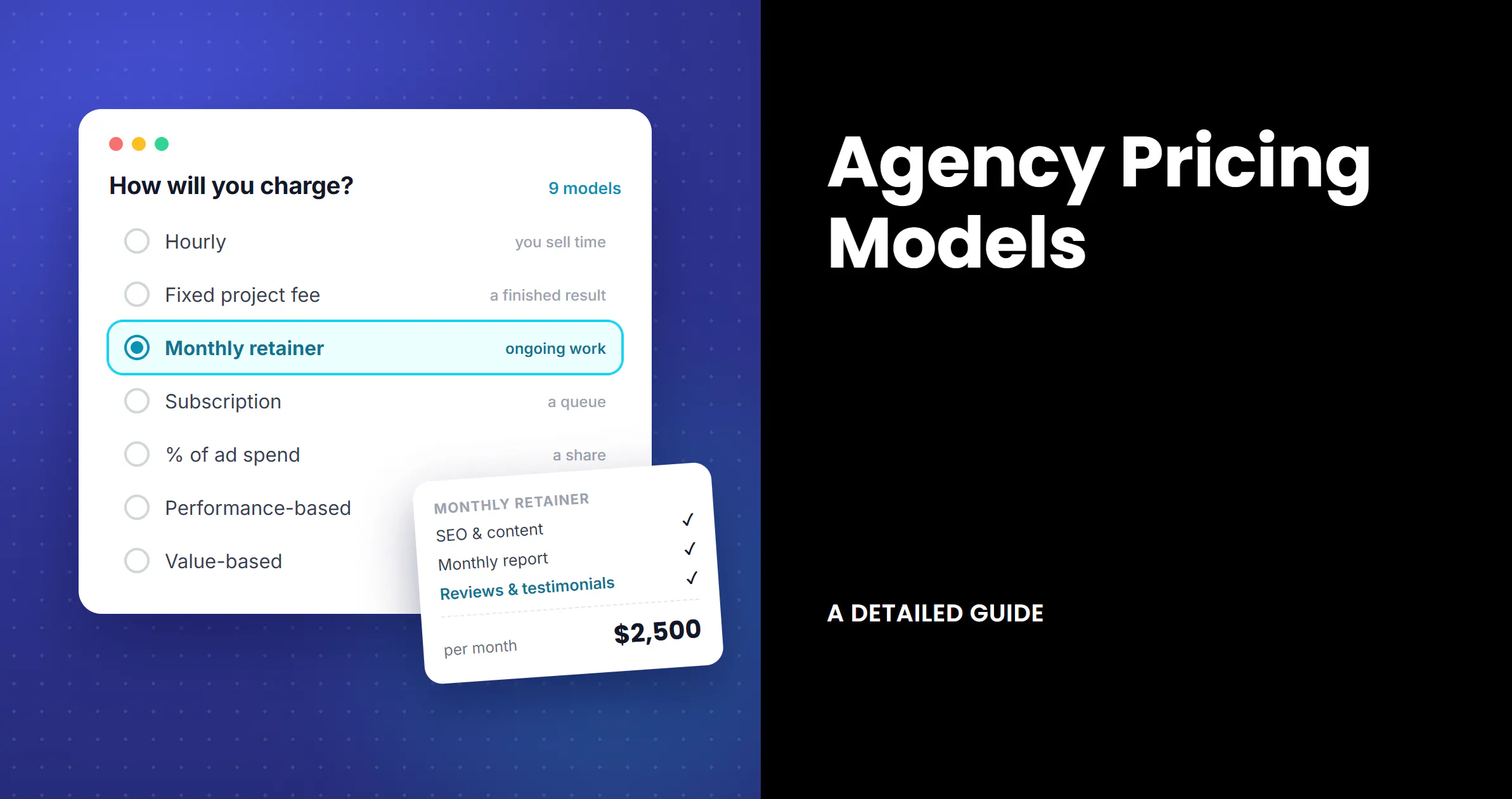
- Hourly: you sell time. Best for audits, consulting & small fixes.
- Fixed project fee: you sell a finished result. Best for websites, rebrands & launches.
- Monthly retainer: you sell ongoing work. Best for SEO, content, social & care plans.
- Productized package: you sell the same deliverable at a published price.
- Subscription: you sell a queue of requests for a flat monthly fee.
- Percentage of ad spend: you take a share of the media budget.
- Performance-based: you get paid per lead, sale or booked call.
- Value-based: you price what the result is worth to the client.
- Hybrid: a base fee plus one of the above. It's where most agencies end up.
Here's how the 9 compare side by side.
| Model | How you charge | Best for | The catch |
|---|---|---|---|
Hourly | A rate per hour or per day | Audits, consulting & small fixes | You earn less as you get faster |
Fixed project fee | One price for a defined scope | Websites, rebrands & launches | Scope creep comes out of your margin |
Monthly retainer | The same fee every month | SEO, content, social & care plans | The client must see value every month |
Productized package | A published price for a set deliverable | Audits, setups & landing pages | Only works if delivery is repeatable |
Subscription | A flat fee for a queue of requests | Design, creative & dev tasks | Heavy users eat the margin |
% of ad spend | A share of the monthly media budget | PPC, paid social & media buying | The fee rises when the work doesn't |
Performance-based | A fee per lead or sale, or a revenue share | Lead gen you can track end to end | You carry risk you don't control |
Value-based | A share of what the result is worth | Strategy, rebrands & big launches | Needs trust and the client's numbers |
Hybrid | A base fee plus one of the above | Most agencies past a few clients | Every moving part needs a contract line |
What is an agency pricing model?
An agency pricing model is the rule that turns your work into an invoice. It decides whether the client pays for your time, your output or the result.
That choice also decides who carries the risk.
Bill by the hour and the client carries the risk of the work running long. Quote a fixed fee and that risk moves to you.
Get paid per lead and you carry the risk of things you don't control, like the offer and how fast the sales team calls back.
The models also differ in how predictable your monthly revenue is. Here's where each one sits.

There's no single best model on that map. The right one depends on how the work behaves, which the rest of this guide walks through.
Here are the 9 agency pricing models
Each model below has 3 parts. How to price it, who it's best for and the catch nobody mentions on the sales call.
1. Hourly pricing - You sell time
You bill for every hour the team works, at an hourly rate or a day rate.
It's how most freelancers start and how agencies price work that nobody can scope yet.
How to price it:
Start from your cost, not a competitor's rate card. Work out what 1 hour of delivery costs you once salaries, software and overheads are in.
Then divide that cost by 1 minus the margin you want. If an hour costs you $50 and you want a 50% margin, your floor is $100 an hour.
Check it against the market after that. Clutch's pricing data on 106,043 digital marketing companies puts the average US agency at $100 to $149 an hour.
Best for:
Audits, consulting, troubleshooting and small changes that fall outside a retainer.
The catch:
You earn less the faster you get. A task that took 5 hours last year and takes 2 hours now pays 60% less.
Clients also start watching the clock, so every call and email feels like a meter running.
2. Fixed project fee - You sell a finished result
You quote one price for a project with a clear finish line, like a website, a brand identity or a launch campaign. It's also called project-based pricing.
Bigger clients increasingly prefer to pay this way.
In the ANA's 2022 Trends in Agency Compensation study, 53% of the biggest advertisers used fixed or output-based fees.
Those are marketers spending $500 million or more a year. In 2016 the share was 5%.
How to price it:
Estimate the hours for each phase and multiply by your hourly floor. Then add a buffer for the unknowns.
Write down exactly what's included, how many revision rounds there are and what a change request costs.
Most agencies split the payment into milestones, like half upfront and half at launch.
Best for:
Websites, rebrands, launch campaigns, audits and anything with a clear end date.
The catch:
Scope creep comes out of your margin instead of the client's budget.
The revenue also stops when the project does. So pair every build with a care plan or a retainer after launch.
3. Monthly retainer - You sell ongoing work
The client pays the same fee every month for an agreed scope of ongoing work.
It's the favorite model of the agencies SE Ranking surveyed. In its 2025 agency pricing survey of 260 mostly small SEO agencies, 53% preferred monthly retainers over every other model.
It's easy to see why, as a retainer gives you recurring revenue you can plan hires around.
How to price it:
Cost 1 typical month of delivery, then apply the same margin rule. The full method is in the retainer section further down.
Decide early whether you sell hours or deliverables.
An hours-based retainer buys a bucket of time each month while a deliverable-based retainer buys a list of outputs.
Best for:
SEO, content, social media, paid ads management and website care plans.
The catch:
The client has to feel the value every single month.
In a quiet month the invoice looks the same and the work is invisible. That's when retainers get cut, so protect yours with a minimum term and something the client can see each month.
4. Productized package - You sell the same deliverable at a published price
You turn a service into a product with a fixed scope and a fixed price. Usually anyone can see both on your website.
Atrix Digital, for example, sells a marketing audit at $195, $395 or $595 and a landing page sprint for $900 to $2,000.
Packaging is already the norm in SEO as 85% of the agencies in SE Ranking's survey bundle their services into packages.
How to price it:
Deliver the service a few times and time every step. Then price the average plus your margin.
Write the scope so tightly that 2 different clients get the same thing.
Best for:
Audits, account setups, landing pages, reports and any service you deliver the same way every time.
The catch:
It only works if the delivery really is repeatable. The first custom request you accept turns the product back into a project.
5. Subscription pricing - You sell a queue of requests
The client pays a flat monthly fee and sends requests into a queue. You work through them 1 or 2 at a time.
Designjoy is the best-known example. Its Monthly Club costs $4,995 a month for 1 request at a time with an average 48-hour delivery.

The limit on active requests is what makes "unlimited" possible to deliver. Some agencies use credits instead, where each type of task costs a set number of credits from a monthly allowance.
How to price it:
Work out how many requests 1 person can finish in a month at your turnaround time. Then price the plan so that 1 person's monthly output covers their cost and your margin.
Best for:
Graphic design, ad creative, video edits and web development tasks that arrive in small & steady pieces.
The catch:
A few heavy users can eat the margin. And "pause or cancel anytime" makes leaving as easy as signing up.
It also isn't the same as a retainer. A retainer sells an agreed scope while a subscription sells access to a queue.
6. Percentage of ad spend - You take a share of the media budget
Your fee is a percentage of what the client spends on ads each month.
It grew out of the old media commission, the classic media agency pricing model. It's still common in PPC and paid social.
How to price it:
Set a percentage, a monthly minimum and a lower rate once spend passes a threshold.
For example, charge 15% on the first $20,000 of spend and 10% above it, with a $1,500 minimum. A client spending $10,000 a month pays $1,500 and a client spending $50,000 pays $6,000.
Those numbers are an illustration, not a benchmark. Run your own costs through them before you quote.
Best for:
PPC, paid social and media buying, where the work grows as the budget does.
The catch:
The fee rises with spend even when the work doesn't, and clients notice when they scale. It can also look like you're paid to push the budget up.
A flat fee per spend tier fixes both. Atrix Digital's $2,995 tier, for instance, includes paid media management up to $5,000 of ad spend.
7. Performance-based pricing - You get paid for results
You get paid per qualified lead, per booked call, per sale or as a share of revenue. If nothing comes in, you earn little or nothing.
How to price it:
Start from what 1 result is worth to the client and what it costs you to produce it.
Then define the result in writing. Say what makes a lead qualified, which tool records it and what happens with duplicates and refunds.
Best for:
Lead generation where you run the whole campaign and can track a lead from the click to the CRM.
The catch:
You carry the risk for things you don't control, like the offer, the price and how fast the sales team calls back.
Even clients aren't sure it works.
8. Value-based pricing - You price what the result is worth
The price comes from the value of the outcome to the client, not from your hours.
A rebrand that helps a firm win bigger contracts is worth far more than the hours it took. Value pricing charges for that.
How to price it:
Ask value questions before you quote. What's a new customer worth? How many more do they need this year? What does it cost them if nothing changes?
Then price as a share of that value. Offer 3 options at 3 prices so the conversation becomes which option, not whether to buy.
Best for:
Positioning, rebrands, go-to-market strategy and launches where the outcome is big and easy to see.
The catch:
It needs trust, a track record and a client willing to share their numbers. Procurement teams that compare hourly rates side by side make it very hard.
And it isn't performance pricing. Value-based pricing sets the price before the work starts, while performance pricing makes the payment depend on what happens after.
9. Hybrid pricing - You mix a base fee with one of the others
Most agencies end up here. A base fee keeps the lights on and a second model handles what the base can't.
The common mixes look like this:
- A one-time setup fee plus a monthly retainer.
- A retainer plus a bonus for hitting an agreed result.
- A flat management fee plus a percentage of ad spend above a threshold.
- A paid audit that leads into a retainer.
Atrix Digital's pricing page shows several of these at once. It sells audits at a fixed price and 4 retainer tiers from $995 to $4,995 a month. On top sit a one-time onboarding fee and fixed-price projects.

Notice that each tier says who it's for and which numbers it moves. That makes the step up to the next tier easy to sell.
Best for:
Agencies with more than one service, or clients who want a predictable bill with some upside.
The catch:
Every extra moving part needs a line in the contract. If the client can't explain their bill in 1 sentence, it's too complicated.
Which pricing model should your marketing agency use?
Pick the model that matches how the work behaves.
Ongoing work wants a retainer and work with an end date wants a fixed fee. Results you control and can track can carry a performance piece on top.
For most small agencies that means a deliverable-based monthly retainer sold in 3 tiers. Add a setup fee, and use fixed fees for anything with an end date.
Here's how that plays out by agency type.
Web design agencies: a fixed fee for the build, then a care plan
Quote the website as a project. Then move the client onto a monthly care plan at launch so the relationship doesn't end with the invoice.
The care plan can cover updates, hosting, speed and keeping the client's reviews live on their Webflow site or WordPress.
SEO and content agencies: a deliverable-based retainer
SEO and content work never really finishes, so a retainer fits. Sell outputs like pages, posts and fixes rather than hours.
PPC and media agencies: a flat fee per spend tier or a percentage with a minimum
Media agency pricing models usually follow ad spend. A flat fee per spend band keeps the bill predictable and removes the "you just want us to spend more" doubt.
Creative agency pricing models: fixed fees for brand work, a subscription for production
Brand identities and campaigns have an end date, so price them as projects. The steady stream of ads, social graphics and edits after that fits a subscription.
Social media agencies: a retainer priced by platforms and posts
Price by the number of platforms, posts a month and whether community management is included. Keep ad spend outside the fee.
Lead generation agencies: a base fee plus a fee per qualified lead
The base fee covers your fixed work. The per-lead fee rewards results without leaving you unpaid in a slow month.

If you sell more than one of these, you'll end up with a hybrid. That's normal as long as each service has its own clear rule.
What do digital marketing agencies charge in 2026?
Digital marketing agency pricing varies a lot by country, size and service. Use the numbers below as a sanity check, not as your rate card.
- Clutch puts the average US digital marketing agency at $100 to $149 an hour. Its data covers 106,043 companies and was updated in September 2026.
- Projects reviewed on Clutch typically cost $10,000 to $49,999.
- In SE Ranking's survey, 64% of the mostly small SEO agencies charged under $1,000 a month for a retainer. Only 2% charged over $5,000.
- Published examples run from $995 a month for Atrix Digital's first retainer tier to $4,995 a month for Designjoy's design subscription.
What is a marketing retainer?
A marketing retainer is a monthly agreement where a client pays a fixed fee for an agreed scope of ongoing marketing work.
Instead of quoting every task, the agency and the client agree on what happens each month. The price stays the same while the work continues.
A retainer for a marketing agency usually takes 1 of 3 shapes:
- Hours-based, where the client buys a set number of hours a month. Say whether unused hours roll over or expire.
- Deliverable-based, where the client buys a list of outputs like 4 blog posts, 2 email campaigns and a monthly report.
- Strategy plus execution, where a fixed strategy fee sits next to a delivery budget the team draws from.
A retainer isn't unlimited work. It usually leaves out ad spend, paid software, stock assets and anything big enough to be its own project.
How to price a marketing retainer in 4 steps
Pricing a retainer is the same margin math as hourly pricing, done for a whole month.
Step 1: Cost 1 typical month of delivery
List every task in a normal month and the hours each one takes. Multiply the hours by what an hour costs you.
Then add the software and contractors that exist only because of this client. The tools in your agency tech stack that every client shares belong in your overheads instead.
Step 2: Divide the cost by 1 minus your target margin
That's your floor. If a month costs $1,200 to deliver and you want a 50% margin, the floor is $2,400.

The margin isn't all profit. It still has to pay for sales, admin, your office and the months between clients.
Step 3: Check the floor against value and the market
Ask whether the client would happily pay that for what the work is worth to them. Then see where it sits against the benchmarks above.
If the floor is higher than the value, cut scope rather than price.
Step 4: Package the retainer into 3 tiers
Build the middle tier for the client you want most. The top tier makes the middle look reasonable and the bottom tier gives a way in.
Marketing retainer packages: a 3-tier template you can copy
Here's a starting point for marketing retainer packages. Swap the lines for your own services and price each tier from its own cost floor.
| What's in it | Starter | Growth | Scale |
|---|---|---|---|
Best for | 1 channel, getting started | 2 to 3 channels, steady growth | Several channels, a bigger team |
Strategy | A quarterly plan | A monthly plan & call | Fortnightly calls & a named strategist |
Content | 2 blog posts a month | 4 posts & social content | 8 posts, social & email |
SEO | On-page fixes | On-page & local SEO | Technical, local & links |
Paid ads | Not included | Management up to a spend cap | Management & creative testing |
Reviews & testimonials | Existing reviews live on the site | New testimonials collected monthly | Text & video, a wall per service |
Reporting | A monthly email report | A monthly report & call | A dashboard & monthly review |
Revisions | 1 round | 2 rounds | 2 rounds & priority turnaround |
Term | 3 months, then monthly | 3 months, then monthly | 6 months, then monthly |
Each step up should add something the client can see, not just more hours. The reviews and testimonials row is the easiest way to do that, and the last section explains why.
Marketing retainer contract template: 8 clauses that stop scope fights
Most retainer fights come from something nobody wrote down. These 8 clauses cover the usual ones.
1. Scope: Each month we deliver [list the deliverables]. Anything not listed is out of scope. 2. Out-of-scope work: We quote it before we start, at [hourly rate] or a fixed fee. 3. Hours: Unused hours [expire at the end of each month / roll over for 1 month only]. 4. Term: The first [3] months are fixed. After that either side can end the agreement with [30] days' written notice. 5. Fees & payment: [Fee] a month, invoiced on the [1st] and paid in advance. Work pauses if an invoice is [14] days late. 6. Third-party costs: Ad spend, software, stock assets and printing are billed separately [at cost / at cost plus X%]. 7. Approvals: [Client contact] approves all work. Each deliverable includes [2] rounds of revisions. 8. Ownership & access: The client owns its accounts, data and finished work once paid. We work through our own logins.
The retainers that last have a line the client sees every month
A lot of retainers end in a quiet month. The client looks at the invoice and can't see what changed.
SE Ranking's survey shows how much keeping clients is worth. Half of the agencies had worked with their clients for 2 years or more, and those agencies charged the highest fees.
The share charging over $1,000 a month almost doubles when clients stay past 2 years. The agencies that keep clients under 6 months all charge $1,000 a month or less.
So every retainer needs at least 1 line the client can point to each month. A report counts, and so does a new page. So does a wall of fresh testimonials on their own website.
Reviews and testimonials make an easy retainer line
The client already understands it, so there's nothing to explain. Every month new reviews and testimonials from their recent customers go live on their site.
The work behind it is small once it's set up:
- Collect the client's existing reviews on day one. It's step 3 of our client onboarding checklist.
- Send their recent customers 1 link each month to write a testimonial or record a video in the browser.
- Approve the best ones so the wall on the client's site updates by itself.
- Put the views and clicks in your monthly report.
Be clear about what that line doesn't cover. Famewall doesn't reply to Google reviews or send reminder emails for you. If you sell review replies, that's your team's time and it belongs in the price.
Run every client in their own white-labeled workspace
On Famewall's Agency plan each client gets their own workspace with their walls and collection pages. Nothing mixes with another client's.

It's fully white-labeled, so clients see your logo on the dashboard and your name on the emails. Team members only see the clients you assign to them.
That's why some studios sell it as white-label review & testimonial management.
For the monthly report, views, clicks and click rate are broken down by client over 7, 30 or 90 days.

That turns "what did we get this month?" into a number the client can see.
Bill it or bundle it, your call
Some agencies charge the reviews & testimonials line on its own. Others fold it into the middle tier to make the step up easier to sell.
Either way the cost side stays flat. The Agency plan is $149 a month for unlimited client workspaces, so across 10 clients the software costs $14.90 per client.

That flat cost is what protects the margin on this line. Some testimonial software for agencies charges more with every client you add, so the line earns less as you grow.
These 6 agency pricing mistakes quietly cost you margin
- Copying a competitor's prices instead of starting from your own cost floor.
- Selling hours to clients who really want a result.
- Offering "unlimited" without a limit on active requests.
- Running retainers with no minimum term, so a client can leave after 1 quiet month.
- Hiding ad spend, software and printing inside your fee. Bill them separately, at cost or with a stated markup.
- Never raising prices.
Agency pricing models FAQs
What are the 4 main agency pricing models?
The 4 main agency pricing models are hourly pricing, fixed project fees, monthly retainers and performance or value-based pricing. Most agencies mix 2 of them, like a retainer for ongoing work plus fixed fees for projects.
What is the most common pricing model for marketing agencies?
The monthly retainer is the most common pricing model for marketing agencies. In SE Ranking's 2025 survey of 260 agencies, 53% preferred retainers over every other model.
How much should a marketing retainer cost?
A marketing retainer should cost at least your monthly delivery cost divided by 1 minus your target margin. Published retainers range from under $1,000 a month at small SEO agencies to $5,000 a month and more for full-service work.
What's the difference between value-based and performance-based pricing?
Value-based pricing sets the price up front from what the result is worth to the client. Performance-based pricing makes the payment depend on the results you actually deliver, like leads or sales.
Want us to set up your first 2 clients?
On Famewall's Agency plan, send us each client's details and the testimonials they already have, and we set everything up for you. Every client gets their own white-labeled workspace on one flat price.