Coaching Questions, Tools and Exercises: What to Ask From the Discovery Call to the Last Session (2026)

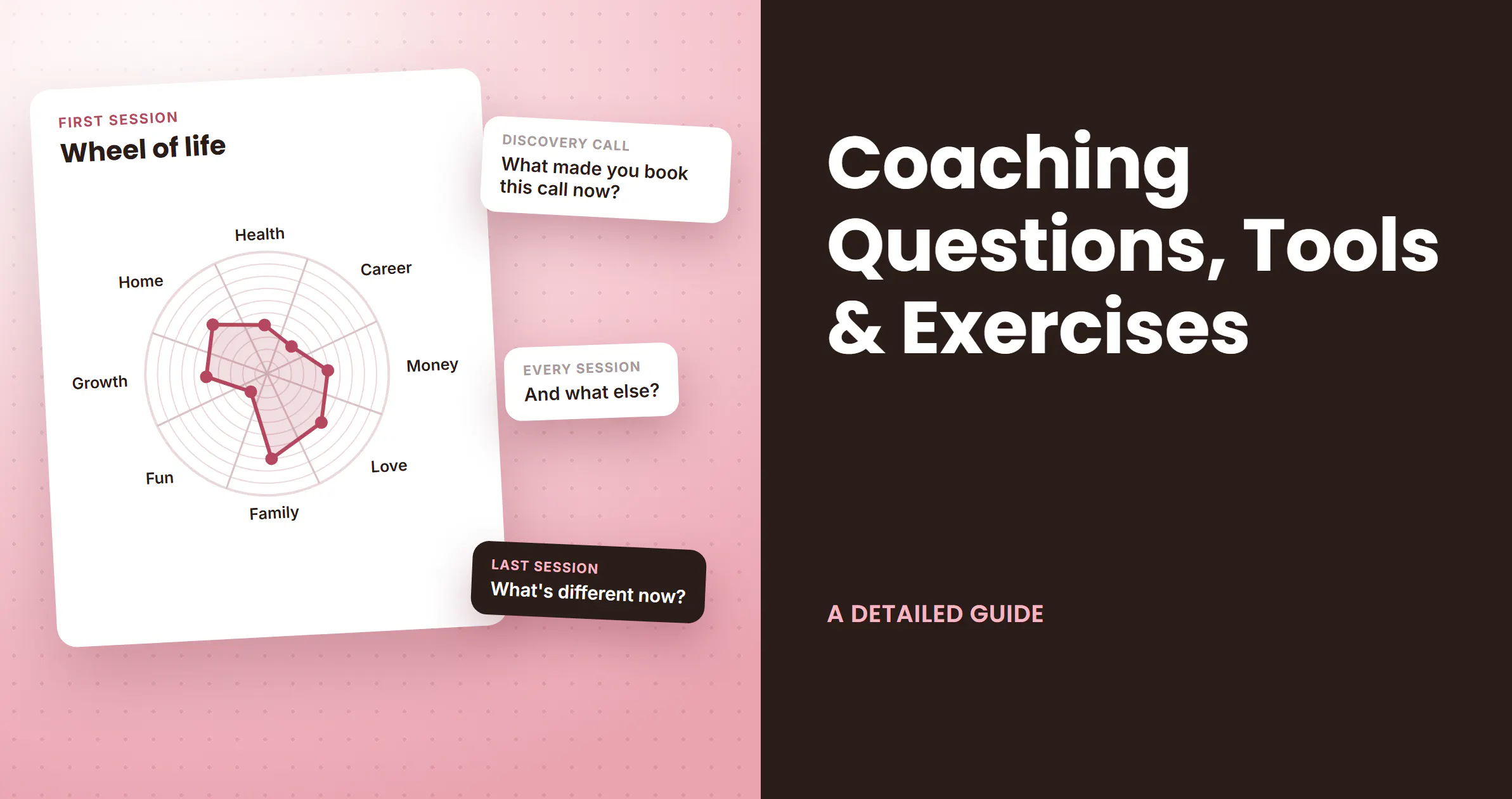
The best coaching question depends on when you ask it.
"What do you want?" is a great opener on a discovery call.
But asking it at the wrong timing usually means the client has lost the thread. Most lists of coaching questions to ask clients ignore timing and sort by topic instead.
You get confidence questions next to career questions and no idea where either one belongs.
This guide sorts them by the stage of a coaching program.
You'll get the questions to ask on a discovery call, in the first session, in every session and on the day a client gets stuck.
Each stage comes with the coaching tools and exercises that fit it, including the wheel of life and the GROW model. Then comes the stage most lists skip: the last session.
Here's the TLDR;
| Stage | Tool or exercise | One question to ask |
|---|---|---|
Discovery call | Fit questions | What made you book this call now? |
First session | Wheel of life | Which area would lift the others? |
Every session | GROW model | What would make this session worth it? |
Between sessions | Check-in form | What got in the way this week? |
Stuck moments | Reframing questions | What almost worked before? |
Last session | Wheel of life again | What's different now? |
The last row is the one most coaches skip. It's also the one that sells your next program. A client's answer to "what changed?" is the testimonial your coaching sales page needs.
A good coaching question is open, short and about the client.
A coaching question helps the client think. It isn't there to help you diagnose.
So what makes one question stronger than another?
Eric Vogt, Juanita Brown and David Isaacs looked at this in their 2003 booklet The Art of Powerful Questions.
They asked people in several cultures to score questions from 1 to 10. "What time is it?" scored low everywhere. "What possibilities exist that we haven't thought of yet?" scored high.
Their rule of thumb is a ladder of question words:
- What, how and why invite the most thinking.
- Who, when and where sit in the middle.
- Which and yes/no questions invite the least.
There's one catch. The authors warn that a careless "why" can make people defensive. "Why did you do that?" sounds like an accusation.
"What made that feel like the right call?" gets the same answer without the sting.

Most closed questions take a few seconds to fix. Here are four open-ended coaching questions made from closed ones:
- "Did you do the homework?" becomes "What got in the way of the plan?"
- "Are you happy at work?" becomes "What part of your work gives you energy?"
- "Should you quit?" becomes "What would you gain and lose if you left?"
- "Why haven't you asked for the raise?" becomes "What would need to be true for you to ask?"
Discovery call questions should find out why now, what they've tried and what success looks like.
A discovery call is a fit conversation. It isn't a free session.
You have 20 to 30 minutes to learn three things. Why is this person looking now? What have they already tried? And what would make the work worth it to them?
The ICF's competencies ask coaches to check "client-coach compatibility" and to agree how success will be measured. Good coaching discovery call questions do both.
Ask why now before anything else.
- What made you book this call now?
- What's happening in your life or business that makes this the right time?
- How much is this on your mind right now, from 1 to 10?
Find out where they are and what they've tried.
- Where are you with this today?
- What have you already tried, and what happened?
- Which of those came closest to working?
- What will it cost you if nothing changes this year?
Ask what success looks like and write the answer down word for word.
- If we worked together for 3 months, what would make it worth it?
- How would the people close to you notice the change?
- What would a normal Tuesday look like once this is solved?
Keep the client's exact words. You'll read them back in the last session. They're the "before" in the client's before-and-after.
Check fit on both sides before you talk about price.
- What kind of support has worked for you before, and what hasn't?
- What would you need to know about me to decide?
- Would it help if I shared how I'd approach this?

Two things to avoid on the call.
Don't coach for free. Name the first step you'd take, then save the work for the program. For most coaches this call is the bridge between a referral and a paying coaching client, so keep it about fit.
Don't ask personal intake questions yet. A coach suggested a simple test for early questions. Would a stranger on the bus answer it? If not, it belongs in the intake form after they say yes.
In the first session, the wheel of life gives every client a baseline you can measure later.
The wheel of life is one of the most widely used first-session exercises in coaching.
It's usually credited to Paul J. Meyer, who founded the Success Motivation Institute in 1960.
The client scores eight areas of life from 0 to 10. Joined up, the scores make a wheel.
A bumpy wheel shows where life feels out of balance. That's often an area the client never mentioned on the call.
Run the wheel of life exercise in six steps.
- Pick 8 areas. The usual set is health, career, money, relationships, family, fun, personal growth and home.
- Swap areas to fit your niche. A business coach might use sales, marketing, team, cash flow, systems, offer, leadership and time off.
- Agree what a 10 means before the client scores anything. A 10 is "as good as I'd want it", not "perfect".
- Ask the client to score each area quickly, from gut feel.
- Join the dots, then ask the debrief questions below.
- Pick one or two areas to work on and save the wheel with today's date.
The last step matters more than it looks. You'll hand the client a blank wheel again in the final session.

Print the worksheet above or draw the wheel on a shared whiteboard during a video call. Both work.
Ask these debrief questions once the wheel is done.
- What surprises you about your wheel?
- Which score would have been different a year ago?
- Which area would lift the others if it moved up two points?
- What would a 10 look like in that area?
- What's one small thing that would move it up one point this month?
The wheel isn't the only first-session tool. Send your coaching intake form questions before the session so you don't spend it on admin.
Then agree the coaching plan, the goals and how the program will end. The ICF's competencies cover all three.
Every session can follow the GROW model: goal, reality, options and will.
GROW is probably the best-known structure for a single coaching conversation.
Graham Alexander, Alan Fine and John Whitmore developed it in the 1980s. Whitmore made it famous in his 1992 book Coaching for Performance.
GROW stops you jumping to advice. You agree a goal, look at reality, list options and end on a commitment.
Here are the GROW model coaching questions to keep next to your notes.
Goal questions decide what this session is for.
These double as coaching questions for goal setting at the start of a program.
- What would make this session worth your time?
- What do you want to walk out with today?
- How will you know we got there?
- Is that a goal for today or for the whole program?
Reality questions show where the client is now.
- What's happening right now?
- What have you tried so far?
- What's in your control here, and what isn't?
- What's the real challenge here for you?
Options questions widen the choices before you narrow them.
- What could you do?
- And what else?
- What would you try if you knew it would work?
- What would you tell a friend in your spot?
- Who has already solved something like this?
Will questions turn the best option into a commitment.
- What will you do, and by when?
- How likely are you to do it, from 1 to 10?
- What would move that number up by one?
- What might get in the way?
- How will I know you've done it?

If a client scores their commitment below 7, shrink the action. A small step they'll take beats a big one they won't.
Between sessions, a short check-in form keeps the work moving.
Most change happens between sessions. A weekly check-in keeps the client moving and gives you notes before the next call.
Send these 5 coaching check-in questions each week.
- What did you get done since we last spoke?
- What got in the way?
- How was your week, from 1 to 5?
- What are you avoiding right now?
- What do you most want to talk about next time?
Michael Hyatt's Full Focus coaches ask clients for a similar one-to-five rating. It works like a thermometer. A run of 2s tells you something before the client says it.
Keep it to 5 questions. Clients answer a short form on their phone. They leave a long one for later.

Open and close every session the same way.
Open with "What's on your mind?" or "What's changed since we last spoke?" Both hand the agenda to the client.
Close with "What was most useful today?" and "What will you do before we next talk?" The first helps the client name what they learned. The second gives you something to check next week.
These 8 coaching tools and techniques work in any niche.
Most of these started as life coaching exercises. They work just as well with business and career clients. Each one fits on a single page, so they make easy life coaching worksheets.
| Tool | When to use it | Question to ask after |
|---|---|---|
Wheel of life | First and last session | Which area would lift the others? |
GROW model | Any single session | What will you do, and by when? |
Values sort | Hard choices | Which value did this choice honour? |
SMART goal sheet | Turning a wish into a plan | How will you know it's done? |
Tolerations list | Low energy, small drains | Which one could you fix this week? |
Future-self letter | A vague vision | What would your future self tell you to stop? |
Energy audit | Burnout or overwhelm | What gave you energy this week? |
Weekly check-in | Between sessions | What got in the way? |
Four of them need a quick explanation:
- Values sort. The client picks five values from a list of 30 to 50, then ranks them. Hard choices get easier once they can name the value at stake.
- Tolerations list. The client lists every small thing they're putting up with, like a broken drawer or a customer who pays late. Fixing a few in one week frees up surprising energy.
- Future-self letter. The client writes to themselves from 5 years ahead and describes an ordinary day. A vague vision turns into details you can coach.
- Energy audit. For one week the client marks each task as energising or draining. The pattern shows what to drop, delegate or redesign.
You don't need to buy a pack of coaching worksheets. The Coaching Tools Company shares free coaching tools and templates.
Scheduling, payments and client portals run the business. That's why the online coaching tools worth paying for look nothing like this list.
When a client is stuck, ask what almost worked and what the smallest next step is.
Every client gets stuck. It usually happens mid-program, once the easy wins are done.
Here are 10 more questions for stuck moments:
- What's the real problem underneath this one?
- What are you avoiding?
- What does staying stuck protect you from?
- If you say yes to this, what are you saying no to?
- What would you do if nobody would ever judge you for it?
- What did you do the last time you got past something like this?
- What would make this 10% easier?
- Who could help you with this?
- What's the smallest step you could take in the next 24 hours?
- What's one thing you could stop doing this week?
When a client says "I don't know", try one of three moves.
- Wait. 10 seconds of silence feels long to you and short to the client. Coaches often say the best next question is no question at all.
- Ask for a guess. "If you did know, what would the answer be?" takes away the pressure to be right.
- Ask what would help them know. Sometimes they really don't know yet. "What would you need to find out first?" turns that into homework.

Silence sits in the ICF's definition for a reason. It's listed right next to powerful questioning.
A question list helps you prepare, but the session should run on the client's words.
Here's the fair pushback on everything above.
Coaching is meant to follow the client. A coach who reads questions off a list stops listening, and clients can tell.
That's true. So use lists before the session and when you're stuck yourself. In the session, three habits matter more than any single question:
- Ask one question at a time. Two questions in one breath let the client answer the easier one.
- Use the client's own words. If they say they're "drowning", ask what drowning looks like on a Tuesday. Don't swap it for "stressed".
- Talk less than they do. Many coaches work to a 70/30 rule, where the client talks about 70% of the time. It's a rule of thumb, not an ICF standard.
If you're talking half the time, you're probably giving advice. That's fine in mentoring. It just isn't coaching.
In the last session, re-take the wheel of life and ask what changed.
Most programs end with a recap and a thank-you. That wastes the best evidence you'll ever have.
The ICF's competencies ask coaches to acknowledge "the client's progress and successes" and to close the relationship with care. The simplest way to acknowledge progress is to show it.
Run the wheel of life again, then compare the two.
Hand the client a blank wheel. Ask them to score it without looking at the first one. Then put both wheels side by side.

This example is made up. Real wheels are rarely this tidy. Some areas jump, some don't move and one may even drop. Each of those is worth a question.
Then read the client's discovery call answer back to them. "You said success would mean this. Where are you with that now?"
Ask these end-of-program coaching questions.
- Look at both wheels. What do you notice?
- What's different now from when we started?
- What did you do that made the biggest difference?
- What are you most proud of?
- What will you keep doing without me?
- What's still unfinished, and what's your plan for it?
- What would you tell someone who's where you were when we started?
- What support, if any, would help you next?
The answer to "what changed?" is your best testimonial.
Look at the 7th question again. "What would you tell someone who's where you were?" is a testimonial. The client just hasn't been asked to put it in writing.
So ask right there in the session:
Would you be open to sharing what changed for you, in a few sentences or a short video? I'd love to show it to people who are where you were. It's completely fine to say no.
Then ask how they'd like to be named. Some clients don't want colleagues to know they had a coach. A first name and a job title is often enough.
Send the link the same day while the session is fresh. Famewall doesn't send reminders for you, so this step is yours.
For context, coaches are the largest group among Famewall's paying customers.
On a Famewall collection page the client can type their answer or record a video testimonial in the browser. Up to 3 of your questions sit under the camera while they record. Nobody freezes on a blank screen.

The questions in that screenshot are the defaults. Swap in your own 3: where they were when you started, what's different now and who they'd recommend the program to.
Nothing goes live until you approve it. The name field is required, but you can rename its label. "How should I credit you?" works fine.
Put the answers on the sales page of the program they came from.
The coaches who get the most from this run one collection link and one wall per program. Collaborate Sports runs a separate wall for each of its 8 mentorship programs. Each wall sits on that program's own page.

That's the step most coaches miss.
Most of the coaches who stopped using Famewall had collected kind words and never put them on their site.
A coaching evaluation form at the last session is half the job. The other half is the client results page your next client reads before they book a discovery call.
Coaching questions: FAQs
What are the 7 coaching questions?
The 7 coaching questions come from Michael Bungay Stanier's 2016 book The Coaching Habit. They are the kickstart, AWE, focus, foundation, lazy, strategic and learning questions. The first 4 ask what's on your mind, what else, what the real challenge is and what the client wants. The last 3 ask how you can help, what they're saying no to and what was most useful.
What is the 70/30 rule in coaching?
The 70/30 rule says the client should talk about 70% of the time and the coach about 30%. It's a rule of thumb, not an official standard. If you talk much more than that, you're probably giving advice instead of asking questions.
How many questions should you ask in a coaching session?
There's no set number. Ask one question at a time and let the answer choose the next one. Plan 3 or 4 questions at most and expect to use one or two.
What's the difference between coaching questions and therapy questions?
Coaching questions look forward, at goals and action. Therapy treats mental health and past trauma, and it needs a licensed professional. The ICF's core competencies ask coaches to keep coaching and psychotherapy distinct and to refer clients on when needed.
Turn "what changed?" into your next client
Famewall gives each program its own collection link and its own wall. Clients answer in text or on video with your questions on screen, and you approve every answer before it shows up on that program's sales page.