I Analyzed 3,616 Testimonial Collection Pages & 15,000 Testimonials. Here’s What Worked

This is the pattern I noticed after looking through high-performing testimonial collection pages on Famewall
I did this study across 3,616 collection pages where customers have submitted more than 15,000 testimonials through Famewall.
I looked at the pages with the highest collected submissions.
The best testimonial collection pages were not just forms with a text box.
They gave the customer a reason to respond.
In fact, they made it simple and used prompts that matched the proof the business needed.
Let's look at the analysis in detail

Quick Answer
A good testimonial collection page includes 5 things:
- A clear reason for the request.
- A simple format choice like text or video.
- 3-5 focused prompts.
- Only the minimal fields you need.
- A clear next step after submission.
The best pages do not ask the customer to appreciate the business but they help the customer remember a specific moment.
Here is the safest structure that you can use for all niches:
Thank you for being part of [experience]. Your story helps others understand what this is really like. Could you answer any 3 of these? 1. What were things like before [product/service/program]? 2. What stood out to you during the experience? 3. What changed for you afterward? 4. What result, win, or moment are you most proud of? 5. What would you tell someone considering [product/service/program]?
That works for many businesses. But it should not be the only page you use.
A course creator, an e-commerce brand, a nonprofit, and a hiring team need different collection pages.
What We Learned From 15,000+ Testimonials
The highest-volume pages had one thing in common.
They reduced blank-page friction.
The customer did not have to guess what to write. The page guided them toward the right memory.
Here are a few patterns from our analysis:
- A live training page collected 504 submissions.
- A course challenge page collected 424 submissions.
- A group fitness page collected 356 submissions.
- A high-ticket program page collected 291 submissions.
- An e-commerce product page collected 234 submissions.
- A video application page collected 231 submissions.
- A professional milestone page collected 200 submissions.

The exact niches changed. The structure did not.
The page explained why the response mattered.
It gave people a specific angle. It asked for a memory, result, recommendation, or personal meaning.
That matters because most customers are not sitting around with polished marketing copy in their heads.
They need a nudge.
The 5 Elements That Keep Showing Up in The Testimonial Collection Page
The strongest testimonial collection pages usually include 5 elements.

1. Context
Tell the customer why you are asking.
It shouldn't be a long essay. It should be just enough to make the request feel human.
Good context sounds like this:
Your story helps future students understand what this course is like.
Weak context sounds like this:
Please leave a testimonial.
The first one gives the customer a purpose, while the second one gives them a task.
2. Format Choice
Some customers will write. Some will record a video. Some will upload a photo.
The best format depends on the proof you need.
Text works well for quick feedback. And video works well when trust is hard to earn. Photos work well for e-commerce and physical products.
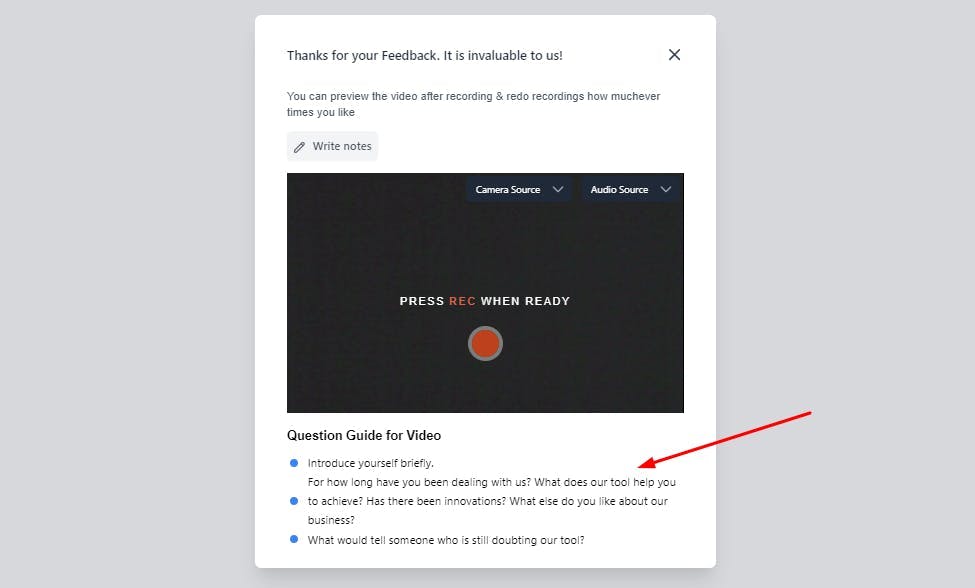
If you want to collect video testimonials, give people prompts before they record.
A blank camera screen is even harder than a blank text box.
3. Focused Prompts
3 to 5 prompts are enough.
You have to keep in mind that the goal is not to interview the customer but to help them tell a useful story.
The best prompts usually ask about:
- What changed.
- What stood out.
- What result did they get.
- What they would tell someone else.
- What the experience meant to them.
4. Identity Fields
Ask for enough detail to make the testimonial useful.
That might be name, role, company, location, course name, instructor name, or product purchased.
Do not ask for fields you will never use. Every extra field adds friction.
5. A Clear Next Step
Tell people what happens after they submit.
Will you review it first? Will it appear on a public wall? Will you contact them for permission?
This is especially important for nonprofits, health stories, hiring pages, and sensitive topics.
Alt: Five elements of a high-performing testimonial collection page.
Testimonial Collection Page Examples By Use Case
Here are 10 collection-page patterns from the Famewall data.
These are not copied customer pages.
They are cleaned-up versions of the patterns that appeared on high-volume pages.

1. Training Session Collection Page
The highest-volume page in the analysis was a live training page. It collected 504 submissions.
The page worked because it guided people back into the room.
It asked about the lesson, the moment that stood out, the recommendation, and the instructor's delivery.
Use this for workshops, webinars, live trainings, conferences, and events.
Thank you for joining [training/session/event]. Your feedback helps us improve future sessions and helps others decide if this is right for them. 1. What was the most valuable takeaway or skill you gained? 2. What specific moment, lesson, or activity stood out to you? 3. If you were recommending this training to someone else, what would you say? 4. How would you describe [host/instructor]'s teaching style?
Why it works:
After a live event, people remember moments and never the polished copy. So use it to your advantage.
The page should pull that memory forward.
2. Course, Challenge, Or Coaching Page
One challenge page in the analysis collected 424 submissions.
Its structure was simple: before, help, result.
That is the shape of a useful course testimonial.
Use this for courses, cohorts, bootcamps, masterminds, challenges, and coaching programs.
Thank you for taking part in [course/challenge/program]. Your story helps future participants understand what is possible. 1. What challenge were you facing before joining? 2. How did [program] help you work through it? 3. What result, change, or win do you see now?
This kind of page is useful for testimonials for course creators because it creates a small case study.
You are not asking the student to say the course was nice, but you are more likely asking what changed.
3. Community, Gym, Or Membership Page
A group fitness page in the analysis collected 356 submissions.
It did not ask about features, but it was oriented more towards belonging.
People do not stay in a fitness class because of a list of features offered.
They stay because of the instructor, the class, the habit, and how the place makes them feel.
Use this for gyms, memberships, creator communities, classes, and local groups.
We would love to hear about your experience with [community/class/service]. 1. What is your favorite part of [experience], and why? 2. Is there a person, class, feature, or moment that stands out? 3. What keeps you coming back? 4. How does [brand/community/service] make you feel? 5. What is your personal reason for being part of this?
Add custom fields if useful. For example:
- Location.
- Instructor.
- Class name.
- Membership type.
Do not force every testimonial into a before-and-after story as some proof works better when it is emotional.
4. Ecommerce Product Review Page
Product review pages worked best when they stayed close to the purchase.
The useful details are simple:
- What did they buy?
- How was the experience?
- What did they like?
- Would they recommend it?
- Can they add a photo?
Use this for ecommerce, handmade products, jewelry, beauty, home goods, and DTC brands.
Thank you for supporting [brand]. Your review helps other customers know what to expect. 1. What did you purchase? 2. What was your experience like? 3. What did you like most about the product? 4. Did it meet your expectations? 5. Would you recommend it to someone else? Why? Optional: add a photo of the product in use.
This matters for testimonials for ecommerce brands because photos often do more work than adjectives.
A testimonial saying "Beautiful" is nice, but a real product photo is stronger.
5. High-Ticket Results Page
One high-ticket program page collected 291 submissions.
The page focused on proof.
Buyers do not only want to know if people liked the program. They want to know what happened after joining.
Use this for high-ticket programs, business coaching, investing education, career outcomes, and premium services.
Thank you for being part of [program/service]. Your results can help others understand what is possible with the right support. 1. What measurable result, growth, or progress have you achieved? 2. Which tool, strategy, mentor, or part of the program helped most? 3. How did the support or guidance affect your progress? 4. What is the biggest change you have experienced since joining?
If proof is visual, add an image upload.
If proof is sensitive, make that optional.
The page should collect evidence without making the customer uncomfortable.
6. Hiring Or Video Application Page
One of the most interesting pages in the data was not a testimonial page at all.
It was a video application page for podcast hosts. It collected 231 video submissions.
That is a useful reminder.
A testimonial collection page is really a structured story collection page. You can use the same workflow any time you need someone to speak naturally.
Use this for hiring, auditions, ambassador programs, scholarship applications, podcast hosts, and creator roles.
Thanks for taking the time to record this. There are no perfect answers. We just want to hear you speak naturally. 1. Tell us a little about yourself. Who are you beyond your resume? 2. Why are you interested in [role/opportunity]? 3. What draws you to this specific work or topic? 4. What experience, perspective, or energy would you bring?
This page should lead with a video if presence matters.
Add custom fields for contact details, availability, timezone, and experience level.
7. Professional Milestone Page
A professional milestone page collected 200 submissions.
The page worked because it made the person part of a larger story.
It was not just "review our association." It was "tell us what this milestone means."
Use this for certifications, associations, alumni communities, member celebrations, and professional groups.
We are celebrating [milestone/community achievement]. Your story helps us show what this achievement means in real life. 1. What motivated you to become part of [community/certification/milestone]? 2. How has it benefited you, your career, or your work? 3. What are you proudest of from this journey? 4. What year or stage did you reach this milestone?
Ask for the milestone year if it helps the story.
That detail makes the testimonial feel grounded.
8. Advocacy Or Nonprofit Story Page
Advocacy pages should not sound like review pages.
Do not ask a supporter to "rate" the cause.
Ask what the cause meant in their life.
You have to ask what changed because of access and what would be at stake if that support disappeared.
Use this for nonprofits, advocacy groups, patient stories, public education, and community campaigns.
Your story can help others understand why this matters. 1. What has [cause/service/community] meant to you or someone you love? 2. What changed when you had access to it? 3. What would it mean if that access, support, or resource was taken away? 4. What do you wish more people understood about this?
This is especially important for testimonials for nonprofits.
Add a consent note if the story may be used publicly. People should know how their words will be used.
Once the stories are in, put them on the pages where people decide to give. To manage this, a nonprofit-specific website builder like Morweb makes it simple to integrate these stories across your donation pages
9. Podcast, Creator, Or Content Feedback Page
The best creator pages focused on the experience.
Questions about the conversation feel like what idea stayed with the person and what would they tell the next guest or listener
Use this for podcasts, newsletters, YouTube channels, creator communities, and media brands.
Thank you for being part of [show/content/community]. Your words help future guests, listeners, or readers understand what this experience is like. 1. What was your experience like? 2. What moment, idea, or conversation stood out? 3. How did it impact you? 4. What would you tell someone thinking about being a guest, listener, reader, or member?
The key is tone.
Creator feedback should feel warm and human and it should not feel like a SaaS NPS survey.
10. Local Service Or Premium Experience Page
For local services, the buyer has more risk.
They are trusting someone with a home, health, family, training, or a major purchase.
The final testimonial collected should reduce that fear.
Use this for real estate, home services, healthcare, training companies, local services, and premium client work.
Thank you for trusting [business/team] with [service]. Your story helps future customers feel more confident in their decision. 1. What were you looking for before choosing us? 2. What part of the experience made you feel confident or supported? 3. Was there a person on the team who made the experience better? 4. What result, outcome, or moment are you happiest with? 5. What would you tell someone considering working with us?
Team shoutouts matter here.
People trust specific humans more than a company name.
How To Build Your Own Testimonial Collection Page
Use this simple decision table.
- If your customer bought because of a result - focus on before, result, and proof.
- If they bought because of transformation - focus on feeling, change, and confidence.
- If they attended a live experience - focus on moment, takeaway, and host.
- If they bought a product - focus on item, purchase experience, quality, and photo.
- If they support a cause - focus on meaning, access, and stakes.
- If they joined a community - focus on belonging, habit, and identity.
The page should match the proof you need. That is the whole point.
How To Create This Testimonial Collection Page In Famewall
If you want one place to collect, approve, manage, and display testimonials, a testimonial collection tool like Famewall helps a lot.

In Famewall, the workflow is simple:
- Create a collection page.
- Choose text, video, audio, or image.
- Add prompts that match your use case.
- Send one clean link.
- Approve the best responses.
- Publish them on a wall of love or website widget.
That last step matters.
Collected testimonials do not help if they stay hidden in a dashboard.
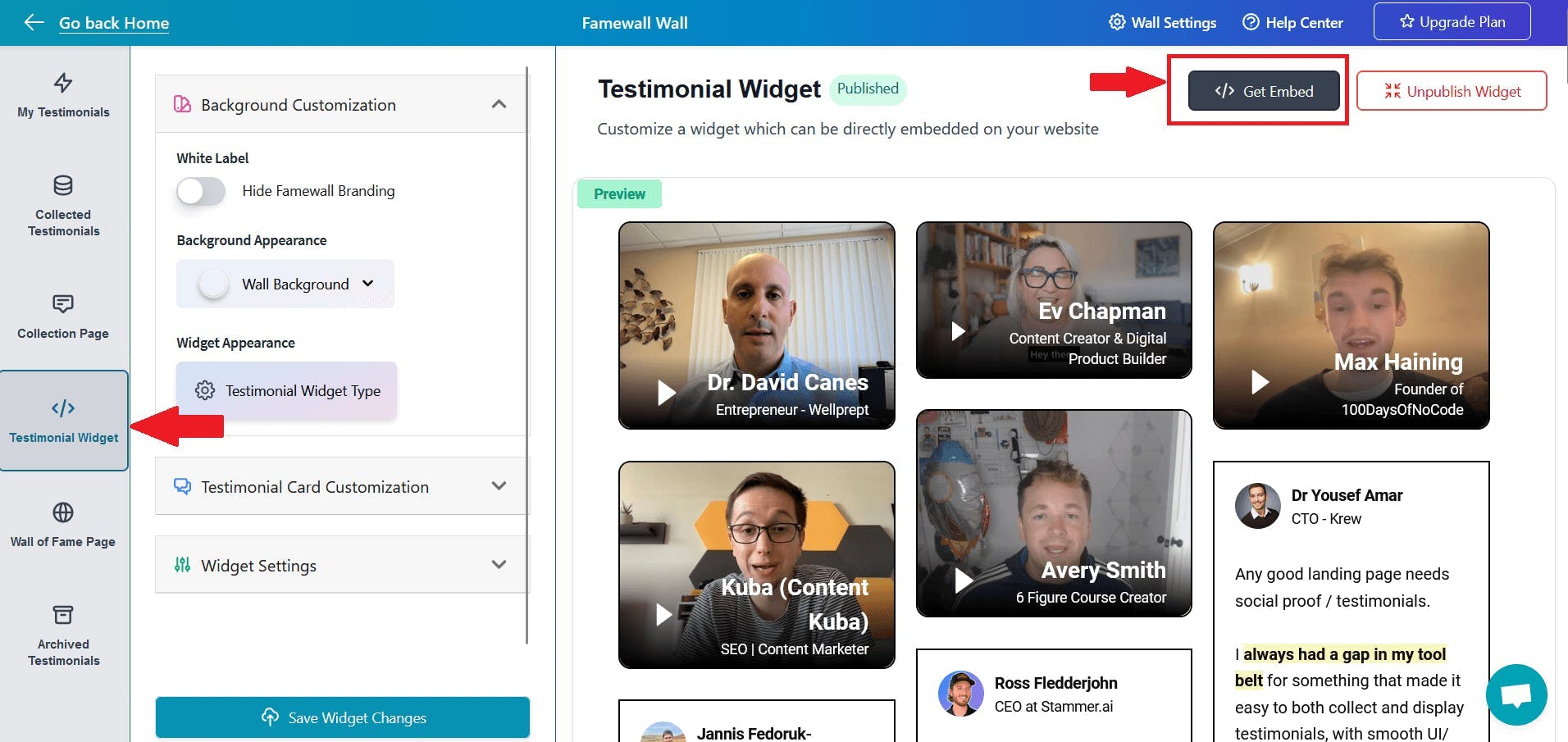
A good testimonial software should help with the whole path.
Collection, approval, management, and display should work together.
FAQ
What is a testimonial collection page?
A testimonial collection page is a dedicated page where customers can submit text, video, audio, image, or written feedback. It usually includes a short message, prompt questions, and fields for customer details.
What should a testimonial collection page include?
A testimonial collection page should include context, format options, 3-5 prompts, identity fields, and a clear next step. The page should make the customer feel guided rather than tested.
How many questions should I put on a testimonial collection page?
Use 3-5 questions. That is usually enough to guide the customer without making the page feel like a long survey.
Should my collection page ask for text or video testimonials?
Use text when you want speed. Use video when trust matters more. Use photos when the product or result is visual.
When should I send customers to a testimonial collection page?
Send the page when the customer has a fresh win. That could be after a course result, product delivery, project milestone, event, or successful service outcome.
Final Takeaway
The best testimonial collection pages do not ask customers to praise you.
They guide people toward the memory that matters.
Start with the experience. Choose the right format. Ask 3-5 focused prompts. Tell people what happens next.
That is how a simple page turns a happy customer into useful proof.
Build a testimonial collection page that people can actually finish
Famewall helps you collect text, video, audio, and image testimonials from one clean link. Add your prompts, approve the best responses, and publish them where buyers can see them.