Coaching Packages: 6 Real Examples, Prices by Niche and How to Price Yours (2026)

There's a lot of bad advice on coaching packages.
Search for it and you'll find high-ticket advice: $5,000 packages, $10,000 programs and $25,000 tiers.
Real sales look different.
Paperbell looked at 23,000+ coaching sales from the past year. The typical multi-session package sold for $736.
That's 6 sessions at about $147 an hour.
So this guide sticks to real numbers. You'll see 6 coaching packages that working coaches sell today, what packages sell for in 9 coaching niches and how to price yours.
For context, we build Famewall, where coaches collect client stories for each program.
So we'll also cover the step most coaches skip: putting proof on the package itself. Here's the TLDR;
- A coaching package is one result, one length of time, a set number of sessions and one price.
- The typical package sells for $736. Leadership coaches get $1,250 and life coaches $500.
- Your niche moves your price more than anything else. Coaching that an employer pays for earns higher fees.
- Price it from your niche's hourly rate times your sessions. Then check it against your income goal.
- 31% of packages sell on a payment plan, so offer one.
- Proof from that exact package is what lets you raise the price. 10 of the 13 coaches we checked had no testimonial on their most expensive package.
Here are the 6 packages at a glance.
| Coach and package | Length | Price and ways to pay |
|---|---|---|
Kate Campion, Self-discovery | 9 sessions over 9 to 12 weeks | $900, or 3 × $300 or 6 × $150 |
Lisa Schmidt, The Next Chapter Strategy | 12 sessions over 6 months | $7,500 |
Kristin Bartholomew, 6-month business coaching | 2 calls a month for 6 months | $2,279, or $399 a month |
NEATOPIA, Accountability Group | 6 group sessions a month, 5 people at most | $125 a month |
Terra Ayres, 6 coaching sessions | 6 sessions within 12 months | $900, or 2 × $450 |
Sam Synett, Business VIP Day | 1 day plus a follow-up call | $1,297, or 2 × $650 or 3 × $450 |
What is a coaching package?
A coaching package is a set of coaching sessions sold as one program for one price.
It promises one result for one type of client over a fixed time. Most include support between sessions and a clear finish line.
Selling a package instead of single sessions changes the conversation. Clients commit to the result rather than deciding again before every call.
It doesn't have to lower your hourly rate either. In Paperbell's data, single sessions sold for about $149 an hour and packages of 6+ sessions for about $150 an hour.
So you don't need to discount a package to sell it.
A good coaching package is built from 7 parts. Use them as a template when you create your coaching packages.

- The promise. One result for one type of client.
- The container. How long it runs, usually 6 weeks to 6 months.
- Sessions and cadence. How many sessions, how long and how often.
- Support between sessions. Email, text or voice notes on Voxer.
- Tools. Assessments, worksheets or a written plan.
- The price. One price, with a way to pay in full and a payment plan.
- The finish line. A last session to review the result and ask what changed.
The finish line is the part most packages leave out. It's also where the proof for your next sale comes from.
6 coaching package examples with real prices
These come from coaches who publish their packages and prices on their booking pages.
We read 94 package pages from 15 coaches on 26 Oct 2026. These 6 each show a different way to build a package.
1. Kate Campion - A 9-session package with a built-in finish line
Kate Campion coaches high-achieving women in midlife. Her Self-discovery package is 8 core sessions and 1 integration session over 9 to 12 weeks.

It costs $900, or 3 monthly payments of $300. Her payment plans cost exactly the same as paying upfront.
Her longer package, Life by design, runs for 6 months. It opens with a 90-minute intake, adds 12 sessions every 2 weeks and closes with an integration session. It costs $1,800.
What you can learn from this:
Build the ending into the package. An integration session shows the client how far they've come. It's also the natural moment to ask what changed.
2. Lisa Schmidt - A narrow niche that carries a $7,500 flagship
Lisa Schmidt coaches accomplished professionals through the side of retirement that isn't about money. Her flagship, The Next Chapter Strategy, is 12 one-hour sessions over 6 months.

It costs $7,500, which works out to $625 a session. Below it sit a 3-month program with 6 sessions for $2,995 and a 90-minute clarity session for $350.
Her Retirement Readiness Index, an online quiz, gives prospects a first step before they book.
What you can learn from this:
A narrow niche carries a higher price. "Leaving a big career with a plan" is easier to price than "life coaching" because the client can picture exactly what they're paying for.
3. Kristin Bartholomew - A 6-month business package priced by the month
Kristin Bartholomew coaches women entrepreneurs. Her 6-month package includes 2 calls a month, with unlimited email and Voxer support between them.

Clients pay $399 a month for 6 months, or $2,279 upfront. Paying in full saves $115.
She also sells ongoing coaching at $399 a month. A 12-month engagement for organizations costs $20,000.
What you can learn from this:
Price the access between calls as well as the calls themselves. Voxer support turns 2 calls a month into an ongoing partnership.
A separate tier for companies lets her charge what employers pay.
4. NEATOPIA - A group rung below the private packages
Yuzu Byrne runs NEATOPIA Coaching & Organizing, organizing and productivity coaching with a focus on ADHD. Her packages climb from a free 20-minute call to a $2,950 signature program.

The first paid step is a small group. It costs $125 a month for 4 accountability sessions and 2 body-doubling sessions, with 5 people at most.
Private coaching starts at $375 a month, or $975 for 3 months.
What you can learn from this:
Give people a smaller way to say yes. Paperbell found coaches list their typical package at $997 but typically sell one for $736.
Clients don't always buy the biggest package on the menu, so make sure there's a smaller one. A group coaching rung is the easiest one to add.
5. Terra Ayres - Testimonials on the package page itself
Terra Ayres is a board-certified health and wellness coach. Her 6-session package costs $900, or 2 monthly payments of $450. The sessions stay valid for 12 months.

Her package page shows 3 client testimonials right beside the price. Anyone reading about the package sees what changed for the people who bought it.
She also runs a $50/month video club and a $150/month live group, so clients have somewhere to go between packages.
What you can learn from this:
Put proof where the client pays. Of the 13 coaches we checked who list prices, 10 had no testimonial on their most expensive package.
That's the page asking for the most trust. Your coaching website needs a results page too, but the package page is where the client decides.
6. Sam Synett - Intensives and a VIP day instead of months of calls
Sam Synett is a trauma-informed coach and licensed clinical social worker. Along with regular coaching, she sells single-topic intensives of about 75 minutes for $397 to $497.

Her Business VIP Day packs 5 to 6 hours of coaching into one day, with lunch included. A 30-minute off-boarding call follows 2 weeks later.
It costs $1,297, or 3 monthly payments of $450.
What you can learn from this:
Not every package needs 3 months. A VIP day suits a client with one urgent problem.
The follow-up call lands when results start to show. That makes it a good time to ask for a testimonial.
How much do coaching packages cost in 2026?
The typical coaching package sells for $736.
That's from Paperbell's 2026 analysis of 23,000+ coaching sales from 1,529 coaches. It counts what clients actually paid at checkout for packages of 2 or more sessions.

About 1 in 5 coaches sells packages for under $300. Only about 1 in 6 gets $2,000 or more.
So if every guide you read starts at $5,000, you're not behind. Most coaches price well below that.
The price on your page isn't always the price that sells
Coaches listed their typical package at $997 on their websites. The typical package they actually sold went for $736.
Paperbell's data can't say why. Our read is that clients don't always buy the biggest package. And a price with no proof beside it is easy to talk down.
How much to charge for life coaching
Life coaches typically sell packages for about $500, or $111 an hour, in Paperbell's 2026 sales data. A single session sells for about $140 across all niches. So a new life coach pricing 6 sessions at $500 to $750 is in line with what clients pay today.
The ICF's 2023 Global Coaching Study put the average fee for a 1-hour session at $244 worldwide and $272 in North America. That covers every type of coaching, including executive coaching.
Session fees hide the unpaid hours
Even those fees overstate what coaches take home per hour.
In the same ICF study, North American coaches charged $272 a session. But they brought in $98 for each hour they spent working as a coach.

The gap is the unpaid part of the job, like marketing, discovery calls, admin and prep. And 53% of coaches in the study earned under $30,000 a year from coaching.
A package price has to pay for those hours too.
Coaching niches set your price more than anything else
Your coaching niche moves the price of your packages more than any other choice you make.
Here's what multi-session packages sold for in Paperbell's 9 biggest coaching niches. Each row covers between 35 and 127 coaches.
| Coaching niche | Typical package | Per hour |
|---|---|---|
Leadership and executive | $1,250 | $200 |
Parenting and family | $1,050 | $154 |
Business | $1,000 | $250 |
Career | $900 | $177 |
Mindset | $775 | $140 |
Spiritual | $675 | $124 |
Relationships | $610 | $112 |
Life | $500 | $111 |
Health and wellness | $450 | $113 |
Leadership and executive coaches sell packages for 2.5 times what life coaches get. Parenting, business and spiritual rest on 35 to 48 coaches each, so treat those 3 as rough.
The ICF found the same pattern. Coaches whose clients are executives charge the highest hourly fees. Fees also rise when someone other than the client, usually an employer, pays.
That doesn't mean everyone should become an executive coach. It means a narrower client with a clearer problem makes a higher price easier to defend.
Coaching niches list: 20 niche ideas coaches sell today
Every niche below is a real offer from one of the 46 coaches whose booking pages we read.
- Career: retirement transitions for senior professionals, career change for introverts, women leaders at a career crossroads
- Business: women entrepreneurs, small business owners fixing their offers and sales
- Leadership and executive: leaders stepping into a bigger role, executives relocating abroad
- Health and wellness: women leaving the weight-loss roller coaster, holistic health habits
- ADHD and neurodiversity: organizing and productivity for adults with ADHD, coaching for autistic and ADHD adults
- Parenting and family: co-parenting after a split, grandparents staying close to their grandkids, homeschooling families
- Relationships: love addiction and codependence, communication for married couples
- Money: budgeting with YNAB, money mindset
- Faith and spiritual: Catholic life coaching, biblical life coaching
Notice how specific they are. "ADHD coaching" is a category. "Organizing and productivity for adults with ADHD" is a niche someone can say yes to.
Life coaching niche quiz: 5 questions to find yours
Answer each question in one sentence.
- Who already asks you for advice? Your niche often starts with the people who come to you now.
- What hard change have you been through yourself? A divorce, a career exit or a diagnosis gives you a story clients trust.
- Who pays: the client or their employer? Coaching paid for by an employer earns higher fees in the ICF's data.
- Can you say the before and after in one sentence? If you can't, the package won't have a clear promise.
- Where would you find 10 of these people this month? A niche you can't reach won't fill a package.

Then read your answers together. An employer who pays points to leadership, executive or career coaching. A life event you've lived through points to a package built around that event.
If question 5 stumps you, narrow down until it doesn't. A niche you can reach is the fastest way to get coaching clients for your first package.
How to price coaching packages in 5 steps
Here's the method, using the real numbers above.
1. Pick one result and the time it really takes
Start with the result, then ask how long it honestly takes. Kate Campion gives self-discovery 9 to 12 weeks, while Lisa Schmidt gives a retirement plan 6 months.
Most packages land between 6 weeks and 6 months. The typical one in Paperbell's data had 6 sessions.
Write the client's "before" down in your coaching intake form on day 1. You'll need it at the end.
2. Multiply your niche's hourly rate by your sessions
Take the hourly rate for your niche from the table above. Multiply it by the number of sessions in your package.
A career coach selling 8 sessions gets 8 × $177, or $1,416. That's in line with what career coaching packages sell for today.
Then add the support between sessions. Voxer access and email reviews are real work, so they belong in the price.
3. Check it against your income goal
Now work backwards from what you need to earn. Divide your yearly goal by the number of packages you can deliver in a year.
Say you want $60,000 a year from coaching. You can carry 12 clients at a time, close to the ICF average of 12.2. Each package runs 3 months, so you deliver 48 packages a year.
$60,000 ÷ 48 = $1,250 per package.

If the income number sits far above your niche's typical price, change something. Carry more clients, add a group program or narrow your niche.
4. Show a pay-in-full price and a payment plan
31% of multi-session packages in Paperbell's data sold on a payment plan. Another 9% sold as monthly subscriptions.
Kate Campion's plans cost the same as paying upfront. Kristin Bartholomew takes $115 off for paying in full. Either works, as long as both options sit on the page.
You don't need a coupon either. Only about 1 in 10 packages sold with a discount code.
5. Add proof from that package, then raise the price
A price with nothing behind it is easy to talk down.
Paperbell's own pricing guide calls the first, lower-priced phase of a coaching business "buying testimonials". You charge less while you collect proof, then you charge more.
So make asking a habit. Ask every client what changed at the last session of the package. A coaching evaluation form gets you the feedback and the testimonial together.
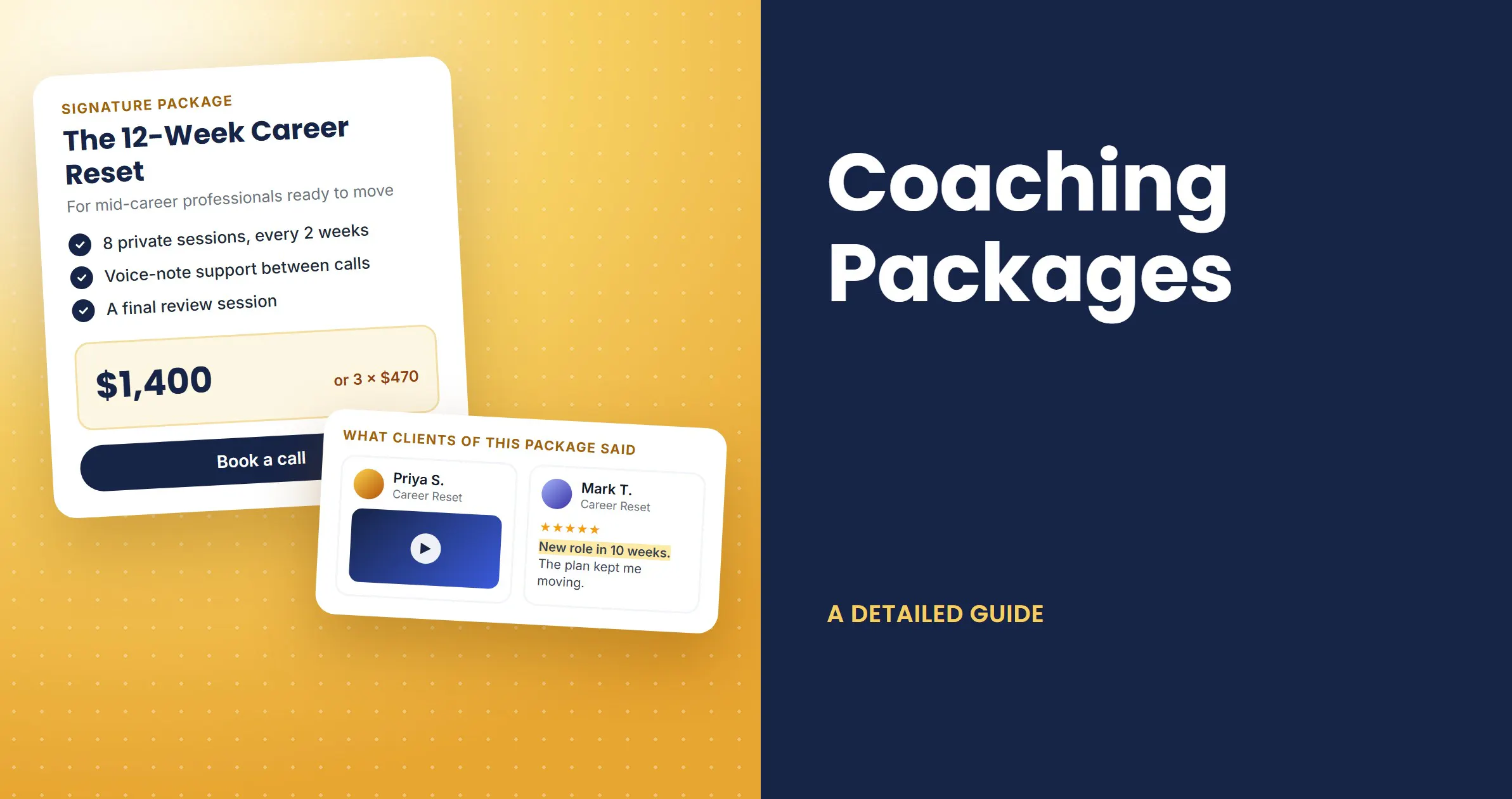
In Famewall, each package gets its own testimonial collection page. Clients write a few lines or record a video in the browser.

Famewall doesn't send reminders for you. You share the link at the last session or in your wrap-up email.
You approve the best stories, and they appear on a wall for that package. Collaborate Sports runs one wall on its 1-to-1 mentorship page and another on its soft skills cohort page.

The wall updates on its own when you approve a new story. It embeds on Kajabi, Squarespace and most site builders that accept embed code.
Famewall's Standard plan costs $15/month and covers 4 packages, each with its own collection page and wall.
Once a package has a handful of specific stories on its page, raise its price for new clients.
Should you sell coaching packages or a monthly subscription?
Some coaches drop packages altogether.
Caroline Leon sold a premium 3-month package for €2,200. She switched to a monthly subscription of about €400 with a 3-month minimum.
Her clients now stay 6 to 12 months. She works with 15+ at once.
That's a real advantage. A subscription has no end date, so a happy client never has to decide to buy again.
It's still the less common choice. In Paperbell's data, 9% of multi-session sales were subscriptions, typically $350 a month for 2 to 5 sessions.
Our take: start with a package that promises one result. Then offer a monthly plan to clients who finish it, the way Kristin Bartholomew does at $399 a month.
The package's clear promise wins the first sale. The monthly plan keeps the client after it ends.
How to name your coaching packages and your coaching business
Name the package after the result rather than the number of sessions.
"6-Session Package" tells a client what they get. "The Next Chapter Strategy" tells them where they'll end up.
The package names in the examples above follow 3 patterns:
- The result: Self-discovery, Life by design, Clear Roadmap
- The client's next chapter: The Next Chapter Strategy
- The format: Business VIP Day, Accountability Group Coaching
For the coaching business name, most coaches keep it simple. 34 of the 46 coaches whose booking pages we read sell under their own name.
A name-based brand moves with you if your niche changes. If you want a brand name, make it say who you help or what changes. The YNAB Coach, The Introvert Ignite and Executive Depth Coaching all do.
Before you commit, check that the .com and the social handles are free. Then run a trademark search. The USPTO's free trademark search covers the US.
Coaching packages FAQs
What should a coaching package include?
A coaching package includes a clear result, a fixed length, a set number of sessions, support between them and one price with a payment plan. The best ones end with a review session where you look back at the result and ask the client what changed.
How many sessions should a coaching package have?
6 sessions is typical. In Paperbell's 2026 sales data, the typical multi-session package had 6 one-hour sessions. Business coaches sell the shortest packages at 4 or 5 sessions, and parenting coaches the longest at 7 or 8.
How much does a life coach cost per month?
Monthly coaching with 2 to 5 sessions typically sells for $350 a month, and 1 session a month for $175, in Paperbell's 2026 data. Life coaches' multi-session packages typically sell for $500.
Should you list coaching package prices on your website?
Yes, if you can. A listed price filters out people who can't afford you before the discovery call. All 6 coaches above put their prices on their booking pages.
Put proof on every coaching package
Famewall gives each package its own collection link and its own wall. Send the link at the last session, approve the best stories and they show up on that package's sales page.