Customer Advocacy Program: How to Build One & 10 Activities Ranked by Reach (2026)

Most customer advocacy programs are built backwards.
They start with the asks.
It asks for a reference call for a big deal, a case study for the website, a speaker for the user conference.
Then the stories sit in a sales deck and a spreadsheet of names. Meanwhile, 61% of B2B buyers prefer to buy without a sales rep.
So most buyers never hear from your happiest customers.
This guide builds a customer advocacy program the other way around. It starts from the pages and moments where buyers decide, then picks the asks that reach them.
For context, we build Famewall & marketing teams use it to collect customer testimonials and publish them on their own websites.
In our data, the walls that get seen most sit on homepages, product pages and trial pages. That's where this guide starts.
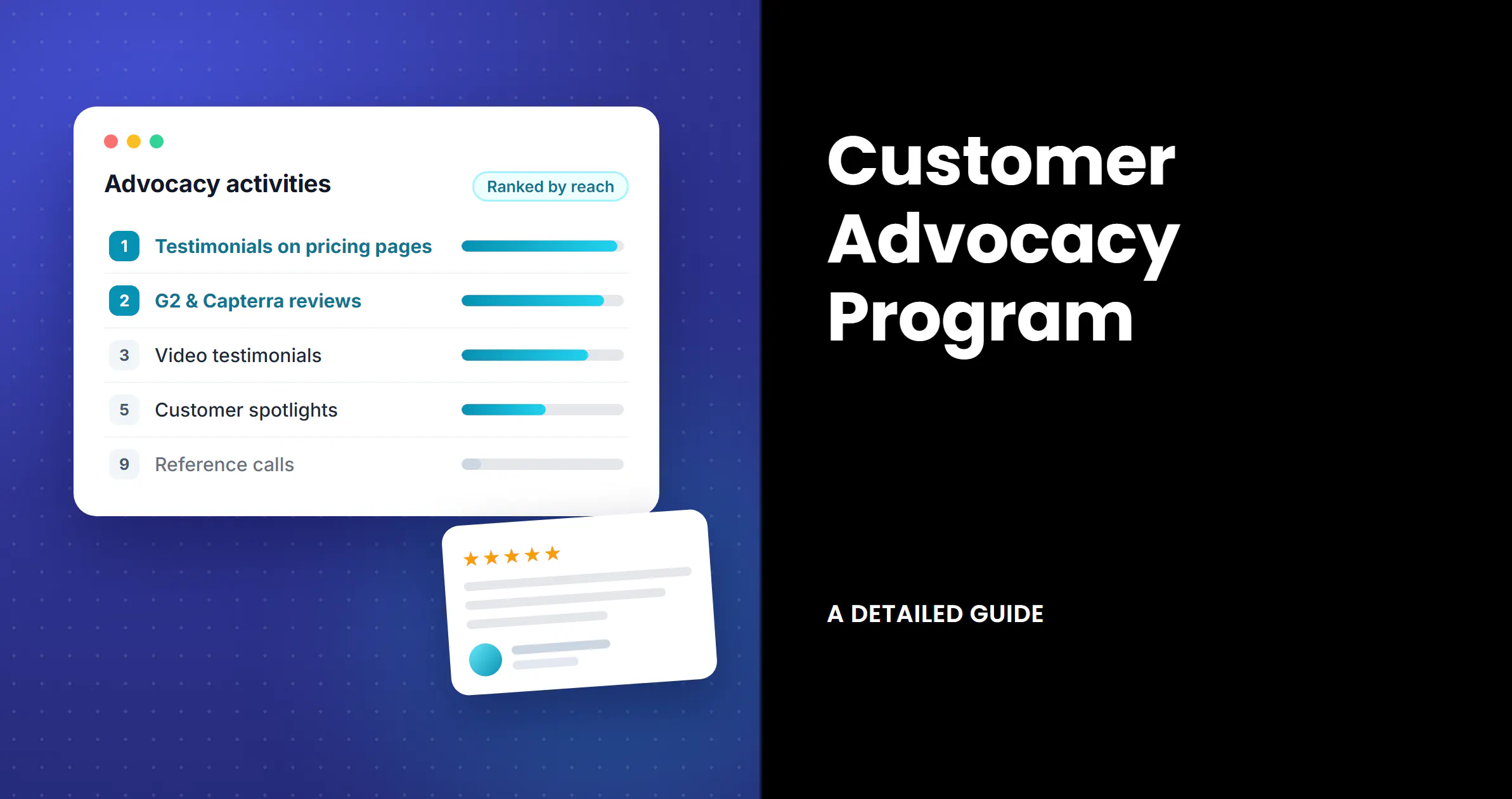
Below are 10 customer advocacy activities, ranked by how many buyers each one reaches.
After them comes a 6-step plan to launch the program in 90 days. Here's the TLDR;
- Testimonials on your product & pricing pages.
- Reviews on G2, Capterra & TrustRadius.
- Video testimonials.
- Social posts from your customers.
- Customer spotlights.
- Case studies.
- Webinars, podcasts & conference talks.
- Referrals.
- Reference calls.
- Advisory boards & beta programs.
Here's what each one asks of your customer, and who it reaches.
| Advocacy activity | Time it takes your customer | Who it reaches |
|---|---|---|
1. Testimonials on product & pricing pages | About 5 minutes | Every buyer who visits those pages |
2. Reviews on G2, Capterra & TrustRadius | 10 to 15 minutes | Every buyer who checks you there |
3. Video testimonials | 5 to 10 minutes | Every visitor, with a face and a voice |
4. Social posts from customers | About 5 minutes | The customer's network of peers |
5. Customer spotlights | 20 to 30 minutes | Your blog, newsletter and social followers |
6. Case studies | 1 to 3 hours | Late-stage buyers and your sales team |
7. Webinars, podcasts & talks | Half a day or more | One audience, once |
8. Referrals | One introduction | One warm buyer |
9. Reference calls | 30 to 60 minutes per call | One buyer per call |
10. Advisory boards & betas | A few hours a quarter | No buyers directly |
What is a customer advocacy program?
A customer advocacy program is a repeatable system for turning happy customers into proof that buyers can see.
You keep a list of advocates, offer them a menu of ways to help and thank them for each one. Then you publish what they say where buyers decide.
Customer advocacy on its own is simpler.
It's word of mouth which could be as simple as a customer recommending you without being asked. The program is how you make that happen on purpose every month consistently.
The output is the point.
A good program fills your website with social proof and your review profiles with recent reviews. It also gives your sales team stories and references they can use the same day.
How does customer advocacy fit into customer marketing?
Customer marketing is marketing aimed at the people who already pay you.
It covers onboarding, adoption, retention, expansion and advocacy.
In most customer marketing strategies, advocacy is the part that faces outward.
It turns your current customers into marketing for your next ones.
That's why the work usually sits in marketing. When UserEvidence read 82 customer marketing job postings from 2025, 24 mentioned references and 23 mentioned advocacy.
Most of the roles reported into marketing leadership.
Customer advocacy program vs reference program vs referral program
These 3 get mixed up all the time. The difference is what the customer does and who it reaches.
| Program | What the customer does | Who it reaches |
|---|---|---|
Customer advocacy program | Picks from a menu of testimonials, reviews, case studies, references, talks and feedback | Buyers on your site, on review sites, on sales calls and at events |
Customer reference program | Talks to a prospect, usually on a call | One buyer in a late-stage deal |
Referral program | Introduces someone new, often for a thank-you | One warm buyer |
Loyalty program | Buys again and earns points or perks | The customer themselves |
A customer reference program is one part of an advocacy program and so is a referral program
Why rank advocacy activities by how many buyers they reach?
Because buyers have changed how they buy. 4 findings from 2025 and 2026 research point the same way.
1. Most buyers decide before they talk to you
Gartner surveyed 632 B2B buyers. 61% said they'd prefer a buying experience with no sales rep.
G2 found something similar in its 2025 buyer behavior research. Nearly 2 in 3 buyers only want to talk to salespeople in the later stages of a purchase.
So proof that only travels through a sales conversation misses most of the decision.
2. Buyers trust reviews and testimonials more than reference calls
UserEvidence asked 811 B2B software buyers, sellers and marketers which customer evidence they trust.
In its Evidence Gap report, third-party reviews scored 57% with buyers.
Case studies and testimonials scored 52%. One-to-one reference calls scored 38%.
Sellers do the opposite. 57% of them share reference calls which buyers rank near the bottom.
TrustRadius found the same pattern in its 2026 B2B Buying Disconnect report. 74% of buyers read customer reviews and 53% spoke to a peer. Vendor marketing material ranked last.
3. Buyers want proof from customers like them
78% of buyers in the UserEvidence study ranked proof of success with similar customers among the most important factors. Only 29% said the same about impressive logos.
That changes what you collect. One generic testimonials page isn't enough. Each product, market or industry needs its own proof.
4. Your customer's time is the scarce resource
Marketers in the same study named their biggest blockers. Getting access to customers came first at 47%, then customer approvals at 45% and the time it takes at 43%.
Here's the useful part. The asks that cost a customer the least time are the same ones that reach the most buyers.

Start in the top-left corner of that chart.
Those asks take minutes and reach buyers you'll never meet. Reference calls sit at the other end, so they belong at the end of the list.
Here's a list of 10 customer advocacy activities, ranked by how many buyers they reach
Each one comes with what it asks of your customer, where it works best and the catch.
1. Testimonials on your product & pricing pages - It reaches every buyer who visits
This is the smallest ask you can make, and it reaches the most buyers.
A customer writes 3 sentences about what changed. You put them on the page where buyers compare plans or start a trial. Everyone who lands there reads them, with no rep in the room.
One of our customers, Clarivate, runs 3 testimonial walls.
One is for the main product, one for the free trial and one for the upgrade offer.
In the last 30 days they loaded more than 100,000 times. A reference call reaches one buyer.
AMBOSS, the medical learning platform, goes a step further. It runs separate walls for different student markets.
To make this work, collect testimonials per product instead of in one big pile.
In Famewall, each product or market gets its own collection page and its own wall. Customers write or record on the page, and you approve what comes in.

Ask one specific question per product, like "What were you doing before, and what changed?"
Specific questions get specific answers, and specific answers are what buyers believe.
Time it takes your customer:
About 5 minutes.
Where it works best:
Product, pricing, trial and comparison pages, each with proof from the product or market on that page.
The catch:
"Great tool, great team!" convinces nobody. Ask for the before and after and show each person's role and type of company so buyers can find themselves.
2. Reviews on G2, Capterra & TrustRadius - It's where buyers go to check your claims
Your website is your side of the story while review sites are where buyers check it.
That's why reviews rank second. They reach every buyer who looks you up on a review site. Buyers trust them because you don't control them.
Reachdesk shows how fast a focused ask can work. It got 7 G2 reviews in the first quarter of 2025. In the same quarter of 2026 it got 107, with the same $20 thank-you.
The team sent plain emails from real people, only to customers who were active in the product.
It also swapped gift cards for physical gifts.
You can also get a review out of an ask you're already making.
On a Famewall collection page, a customer who writes a testimonial can be offered a copy of it. They paste it into G2 or Capterra, and one ask becomes 2 pieces of proof.
It works the other way as well. If you already have good reviews, you can show your Capterra reviews on your website and do the same with G2.

Imported reviews show which site they came from. That matters to a buyer who wants to check they're real.
Time it takes your customer:
10 to 15 minutes, plus signing in to the review site.
Where it works best:
Your G2, Capterra and TrustRadius profiles, then back on your own pages as a rating or a quote.
The catch:
You can't choose what people write. Ask the customers who are getting results, and never tie a reward to a good score.
3. Video testimonials - It puts a real person on your product page
Video does what text can't. Buyers see a face, hear a voice and judge for themselves.
It used to need a film crew and a release form but now a customer records 2 minutes from a link, in the browser, between meetings.
That's how you collect video testimonials on a Famewall collection page.
The recorder shows 3 guide questions under the camera, so nobody stares at a blank screen. You can auto-generate captions afterwards.

Use the same 3 questions you'd ask on a call.
What was the problem, what changed and what would you tell a peer? Then trim the best 30 seconds for LinkedIn and sales emails.
Time it takes your customer:
5 to 10 minutes, including a retake or two.
Where it works best:
Product pages, demo follow-up emails, sales decks and LinkedIn.
The catch:
Fewer people say yes to a camera. Always offer text as well, and treat every video as a bonus.
4. Social posts from your customers - It reaches their network of peers
A customer's LinkedIn post is user-generated content that reaches people you can't.
Their followers often do the same job and face the same problems.
Don't ask a customer to write a post from scratch.
Send them their own quote as an image sized for LinkedIn, plus one line they can edit. A ready-made image of their own words is an easy thing to say yes to.
Famewall's Image Studio can turn any testimonial into a social image in LinkedIn, X, Facebook or Story sizes.

When you post it from your company page, tag the customer and their company. If their team reshares it, the quote reaches their whole network.
Time it takes your customer:
About 5 minutes, if you hand them the image and the words.
Where it works best:
LinkedIn, in the customer's own feed.
The catch:
Some companies limit what employees can post about vendors. Ask first, and never post on their behalf.
5. Customer spotlights - It turns one customer into a story your audience reads
A customer spotlight is a short feature about one customer. It covers who they are, what they do and how they work with you. Agencies call it a client spotlight. Associations call it a member spotlight.
It runs on your blog, in your newsletter or as a LinkedIn post.
Unlike a case study, it's about the customer more than your product. That makes it an easy yes, because it promotes them too.
Cisco even treats a spotlight as a reward. In Cisco Insider, its advocacy community, members who reach the Platinum level get a social media and newsletter spotlight.
Here are 6 questions that make a spotlight easy to write:
1. What does your team do, and who do you serve? 2. What were you trying to fix when you found us? 3. What does a normal week look like with [product]? 4. What result are you proudest of this year? 5. What would you tell a peer who's considering [product]? 6. What's one thing about your team more people should know?
Time it takes your customer:
A 20-minute interview, or answers by email.
Where it works best:
Your blog, newsletter and LinkedIn. Then pull the best line onto a product page as a testimonial.
The catch:
A spotlight mostly reaches people who already follow you. The testimonial you pull from it is what reaches new buyers.
6. Case studies - It answers "Will this work for a company like mine?"
A case study is the long form of proof.
It covers the problem, the rollout and the numbers. Late-stage buyers read them, and sales teams send them.
Build case studies from the testimonials you already have.
The customer has said yes once and the quote is approved. You only need the numbers and a few follow-up questions that get specific answers.
BeyondTrust pitches case studies to its advocates as a way to build their personal brand, in writing or on video. That framing turns a favor into something the customer wants.
Time it takes your customer:
1 to 3 hours across an interview, a review and approvals.
Where it works best:
A case study page organized by industry, sales decks and late-stage follow-ups.
The catch:
Approvals can take weeks. Agree on what you'll share, from the name to the logo to the numbers, before the interview instead of after it.
7. Webinars, podcasts & conference talks - It makes your customer the expert on stage
A customer on stage says what your sales team can't.
They talk about their problem, their choice and their results to a room of their peers.
Most big programs offer this. Zendesk's Luminaries program invites customers to speak at Zendesk events and conferences
Record every session. Cut the best 60 seconds into a video testimonial, and the talk keeps working even after the event.
Time it takes your customer:
Half a day or more, with preparation.
Where it works best:
Your webinars and user conference, industry events and podcasts.
The catch:
It reaches audience, once. Without a recording and clips, it's gone the next day.
8. Referrals - It sends you one warm buyer at a time
A referral is advocacy in its most direct form. A customer introduces you to someone with the same problem.
In B2B the ask is usually simple.
One question at a quarterly review ("Who else should we be talking to?") beats a referral portal. Common thank-yous are a gift, a donation in their name or credit on their account.
Time it takes your customer:
One email or one introduction.
Where it works best:
Customers who know peers with the same problem, asked right after a win.
The catch:
Each referral reaches one buyer. It fills the pipeline, but it doesn't put proof anywhere a stranger can see it.
9. Reference calls - It wins the one deal that needs it
This is where most programs start, and it's the most expensive ask you can make.
As the research above showed, sellers lean on reference calls far more than buyers trust them. Good customer proof often removes the need for a call.
So keep reference calls for big deals in the final stage.
Then run them as a customer reference program instead of a string of favors:
- Keep one central list, not each rep's favorite customers.
- Record each reference's industry, company size, product, role and what they're happy to do.
- Cap the asks. One call a quarter is plenty unless the customer offers more.
- Brief the reference before the call, and tell them how the deal ended.
Here's a reference request you can copy:
Subject: Would you talk to a peer for 20 minutes? Hi [Name], We're working with a [role] at a [industry] company who's weighing [product]. Their situation looks a lot like yours did last year. Would you be open to a 20-minute call with them in the next 2 weeks? I'll send a short brief first, and it's completely fine to say no. If a call doesn't suit you, a short written quote would help too. Thanks, [Your name]
Time it takes your customer:
30 to 60 minutes per call, plus scheduling.
Where it works best:
Late-stage deals where the buyer needs a peer from the same industry.
The catch:
Ask the same 5 customers every quarter and they'll stop replying so spread the asks, and track who was asked when.
10. Advisory boards & beta programs - It reaches no buyers, and that's fine
Some advocacy never reaches a buyer. A customer advisory board or a beta group shapes your product instead.
It still belongs in the program, because it's where your best advocates feel heard.
Cisco Insider runs advocacy, user groups and user research as one program.
Customers who shaped a feature also have a story to tell about it. Invite them to tell it when the feature launches.
Time it takes your customer:
A few hours a quarter.
Where it works best:
Your product roadmap and your most engaged customers.
The catch:
Don't count it as marketing output. Measure it by what changed in the product.
How do you build a customer advocacy program in 90 days?
You don't need a team or a platform to start. You need a map, a short list and the habit of publishing. Here's the plan in 6 steps.
1. Map the pages & moments that need proof
Start with where buyers decide instead of those who might say yes.
List the pages and moments in your buying journey. Write down the question a buyer has at each one, then the proof that answers it.
| Where the buyer is | What they want to know | Proof that answers it |
|---|---|---|
Product page | Does this solve my problem? | A quote or video from someone with the same job |
Pricing page | Is it worth the money? | A result with a number, plus your review rating |
Free trial or demo page | Will my team actually use it? | A quote about setup time or adoption |
Comparison page | Why you and not the other one? | A quote from someone who switched |
G2 or Capterra | What do other customers say? | Recent, honest reviews |
Late-stage deal | Will it work for a company like mine? | A matched case study, then a reference call |
Every row without proof today is a gap. Fill the gaps on your highest-traffic pages first.
2. Shortlist 20 to 30 customers who already got results
Your first advocates aren't simply your most loyal customers or your biggest accounts. They're the customers with a result and a reason to like you. Look for:
- Promoters who gave you a 9 or 10 on your last NPS survey.
- Accounts that renewed or expanded in the last 6 months.
- People who praised you unprompted in an email, a call or a LinkedIn post.
- Customers who already reviewed you on G2 or Capterra.
- Names your customer success team would put forward today.
Then match the list to your map. If the pricing page needs a finance leader, find one.
3. Write a one-page program description
Customers say yes faster when they know what they're agreeing to.
One page covers it: the menu of activities, how often you'll ask, what advocates get and how names and logos are used.
BeyondTrust's public program page is a good model. Participation is opt-in and on the customer's terms, with no requirement to be named publicly.
The only ask is one activity per calendar year.

That minimum is the clever part. One activity a year is an easy promise to make, and it keeps the list active.
4. Make the first ask small & time it to a win
Ask when the customer is happiest. Good moments are go-live, the first measurable result, a strong quarterly review and renewal.
Renewal is the one most teams miss. Liz Richardson of Captivate Collective made that case in a ChurnZero webinar. She argued renewal is a relationship milestone, not an admin task.
Start with the 5-minute ask, a quote or a review.
Keep it short and name the result, like the best testimonial request templates do. Here's an invitation you can adapt:
Subject: You're one of the reasons [product] works Hi [Name], Your team's [specific result] is one of the best results we've seen this year. We're starting a small group of customers who share what's working, in whatever way suits them. It might be a short quote, a review or a quick chat with a peer. There's no obligation, and you choose what you do. Would you start with a 3-sentence quote about what changed for your team? Here's the link: [collection link] Thank you, [Your name]
5. Publish every story within a week
A story sitting in a folder for a month has helped nobody.
Approve it, tag it by product, industry and role, and put it on the page it was meant for. Then tell sales where to find it.
This is the step that usually stalls on a web ticket.
In Famewall, each product or market gets its own wall, embedded on the page once as a testimonial widget. After that, marketing approves new stories in the dashboard and they appear on the site.
The Testimonial Organizer tags stories by theme, so anyone can find the right one for a deal.

Turn on a Slack alert for new testimonials too. Sales and customer success see every new story the day it arrives, and they know who to thank.
6. Close the loop & measure what moved
Tell every advocate where their story lives and how many people saw it. It's the cheapest thank-you there is, and it makes the next ask easier.
Famewall shows widget views for each wall. So you can tell a customer their quote sat on a page that loaded thousands of times this month.

Then track a handful of numbers each month:
- Active advocates, and how many asks each one got.
- Asks completed, by type.
- Key pages with proof, out of the pages on your map.
- Reference requests filled, and how many days each one took.
- Views on your proof pages.
- Deals where sales used a story or a reference.
What should you give customer advocates in return?
Recognition first, gifts second. For a B2B advocate, visibility for their work is usually worth more than swag. Early access to new features costs you little and lands well too.
BeyondTrust's perks show the range. Advocates get a welcome kit, VIP treatment at events, recognition across its channels, press opportunities, certificates and badges. There's an Advocate of the Year award too.
Larger programs add points and levels. Cisco Insider members earn points for taking part.
Gold starts at 25 points a year. Platinum, at 1,000 points, adds a $50 Cisco Store voucher and that newsletter spotlight. Top Diamond members can join a VIP group called Rockstars.

You don't need levels on day one. They earn their keep once you have more advocates than you can thank by hand.
Gifts for reviews need care.
The FTC's Consumer Reviews and Testimonials Rule took effect in October 2024. It allows incentives for reviews as long as they don't depend on the review being positive.
Review sites set their own rules as well. G2's community guidelines cap any incentive at $100 and label incentivized reviews. A thank-you gift for an honest review is fine everywhere.
Customer advocacy program FAQs
What does a customer marketing manager do?
A customer marketing manager runs marketing for existing customers, from onboarding and adoption campaigns to renewals, events, community and advocacy.
What are some examples of customer advocacy programs?
BeyondTrust's Customer Advocacy Program lets customers pick activities, from case studies to confidential reference calls, with a minimum of one a year. Cisco Insider combines advocacy, user groups and user research with points and levels. Zendesk Luminaries gives customers speaking slots at Zendesk events.
How do you get customer references for B2B sales?
Ask right after a customer gets a measurable result. Be specific about who the prospect is and how long the call takes. Keep one central list with each reference's industry and role, cap calls at about one a quarter and get permission before you share a name.
Should you pay customers to be advocates?
Pay them in recognition first, with spotlights, speaking slots and early access. Small thank-you gifts are fine, but never make a reward depend on a positive review, and disclose incentives. G2 caps review incentives at $100 and labels those reviews.
How long does it take to set up a customer advocacy program?
You can launch in 2 weeks and have a working program in 90 days. Week 1 is the proof map and the shortlist, and week 2 is the one-pager and the first small asks. By day 90 you should have proof on your key pages, new reviews and a reference list sales can use.
Put every customer story on the page it was meant for
Famewall gives each product, market or program its own collection link and its own testimonial wall. Your marketing team embeds them on product, pricing and trial pages without a developer ticket.