Fundraising Letter Examples: 7 Real Year-End Appeals and a Template to Copy (2026)

Every fundraising letter template has the same blank.
It sits right under "Dear [First Name]" and says "[insert a story about someone you helped]."
That blank is the whole letter. The greeting, the ask and the P.S. are the easy part.
So this guide skips the empty templates. You'll see 7 real fundraising letter examples from nonprofits, library foundations and associations, and what each one does well.
You'll also get a year-end appeal letter template to copy and a mailing schedule that ends on December 31. And you'll see how to have a real story ready for every program you run.
For context, we build Famewall. Associations like CIPR use it to collect member and program stories on their own websites.
Here's the TLDR;
- A fundraising letter works best with one real person at the center, in their own words.
- Mail your year-end appeal letter by November 13 so it lands before Giving Tuesday on December 1.
- Ask for one amount and say what it buys.
- Repeat the ask and the December 31 deadline in the P.S.
- New for 2026, donors who don't itemize can deduct up to $1,000 of cash gifts ($2,000 if filing jointly).
- Send each donor the story from the program they fund.
- Use the P.S. to ask donors why they give. Their answers become next year's letter.
What is a fundraising letter? A one-page ask built around one person.
A fundraising letter asks your supporters for a gift, by mail or by email.
The good ones tell one story, name one need and ask for one amount. Most fit on one page.
You'll hear a few names for the same idea:
- Year-end appeal letter. Sent in November and December, before the December 31 tax deadline.
- Annual appeal letter. Your once-a-year ask to your whole list. Most nonprofits send it at year-end, so the two often mean the same letter.
- Annual fund letter. What associations and schools often call it when members or alumni give to a foundation.
- Spring, emergency and capital campaign letters. Same shape, different moment.
The year-end appeal matters most because end-of-year giving peaks in December. M+R's 2026 Benchmarks found nonprofits got 37% of all their 2025 online revenue in that one month.
So this guide focuses on the year-end appeal. Everything in it works for the others too.
Here are 7 real fundraising letter examples and what each one does well.
Most fundraising letter examples online are templates with brackets. Even the AI answers say so.
These are real year-end and annual appeals from the last few years. 5 come from small nonprofits, library foundations and an association foundation.
The other 2 come from SOFII, a fundraising archive that publishes each appeal's results.
Each one does at least one thing you can copy this year.
| Letter | What it does well | Copy this |
|---|---|---|
1. Catholic Charities, Flint | Nick tells his own story | One person's own words |
2. Sumatran Orangutan Society | Mails the update with the ask | Your update in the envelope |
3. Urbandale Library Foundation | Lists 6 things gifts paid for | A "your gift paid for" list |
4. Sleep Research Society Foundation | One number members remember | A number members repeat |
5. Interfaith Center of New York | Names this year's challenge first | Open with what changed |
6. Friends of Rockland Library | QR code, reply slip, anonymity | 3 easy ways to reply |
7. Bush Heritage Australia | A thank-you with no ask | Thanks before the ask |
1. Catholic Charities in Flint lets Nick tell his own story.
Catholic Charities of Shiawassee and Genesee Counties sent this 2-page year-end appeal letter for 2025. It's signed by Katie Baxter, the President and CEO.

The letter opens with a short thank-you. Then it introduces Nick, a combat veteran who was living between his car and the woods.
Then Nick tells the story himself, in a box next to his photo. A staff member stopped at the exit ramp where Nick was holding a sign.
Today Nick has his veteran benefits and a safe place to live. He's working toward his next goal.
Only after Nick's story does the letter share the year's numbers, like 300 meals a day in Flint.
Page 2 prices the ask. $20 buys 10 bus passes for veterans going to appointments, and $175 pays for a week in the warming center.
What you can learn from this:
Put one person's own words in the letter, with their photo and their permission. Then let the numbers back up the story instead of opening with them.
2. The Sumatran Orangutan Society mailed its update with the ask.
The Sumatran Orangutan Society is a small UK charity. In November 2024 it mailed its end-of-year appeal with "The Long Call", a short booklet about the year.

The booklet held photos, stories from the field and a simple look at the charity's finances. One story covered the canopy bridges built for orangutans in West Toba.
SOFII's case study shares the results. The mailing raised 67% more than the year before, and the average gift nearly doubled.
The response rate went from 3.3% to 7.9%. Every £1 spent raised £2.95.
The team used photos and stories it already had.
What you can learn from this:
Your impact update doesn't need its own mailing. Put the best of it in the same envelope as the ask.
3. Urbandale Public Library Foundation lists what last year's gifts paid for.
This one-page annual appeal letter went out on November 13, 2025.
It's from John Forbes, president of the Urbandale Public Library Foundation in Iowa.

Instead of a vague "thanks to donors like you", it lists 6 things donors paid for.
There's $250,000 toward redesigning the children's area and adding study rooms. There's a StoryWalk along a park path and an AmeriCorps member for the library's Community Fridge.
Then it asks for a gift to the 2025–2026 campaign.
What you can learn from this:
Show donors the receipts. A list of things people can picture tells them their last gift went somewhere real.
4. The Sleep Research Society Foundation gives members one number to remember.
Associations raise money from members, and members think like professionals. The Sleep Research Society Foundation's 2025 Annual Appeal speaks to them that way.

It names every award and scholarship the appeal pays for. Many are scholarships for students and young investigators, so members are funding their own field's next generation.
Then it gives one number. Every $1 given to the foundation has turned into $14 in later grant funding, based on its award winners from 2005 to 2017.
The page ends by thanking current donors and linking to the donor list.
What you can learn from this:
If you're an association, name the programs and give members one number they'll repeat. A member spotlight from a past award winner would make it personal too.
5. The Interfaith Center of New York names what changed this year in its first line.
The Interfaith Center of New York sent this year-end appeal on November 13, 2025. It's signed by the Rev. Dr. Chloe Breyer, the executive director.

The first sentence is about what New Yorkers are facing in the year ahead. Then one bold line says what the center needs.
5 bullets follow, each starting with a bold action like "Increase our assistance". A skimmer gets the whole ask from the bold words alone.
Then it asks "Can ICNY count on you this December?" and quotes a board co-chair. The P.S. points readers to the annual report coming in December.
What you can learn from this:
Start with what changed this year, in plain words. Then bold the first words of each point so a 5-second skim still lands.
6. Friends of Rockland Public Library makes replying take 30 seconds.
This is the shortest letter on the list. Christa Zuber, president of the Friends of Rockland Public Library in Maine, sent this one-page appeal on November 1, 2025.

It's 4 short paragraphs. They say the library is also a shelter in extreme weather and a pick-up spot for children's summer lunches.
Then it gives 3 ways to reply. There's a QR code, a short web address and a tear-off slip with $25 to $100 boxes and space to write any amount.
The slip also has a box that says "I wish to remain anonymous."
What you can learn from this:
Make replying easy for every kind of donor. Add a QR code for phone users, a reply card for check writers and a way to give without being named.
7. Bush Heritage Australia raised 266% of its target with a thank-you.
This one breaks the rules on purpose. After the 2019–20 bushfires, Bush Heritage Australia swapped its usual autumn appeal for a thank-you pack.

The envelope promised "seven stories of survival" from 7 reserves. Inside was a letter from the CEO about returning to a burnt reserve, and an update on each one.
There was a thank-you card signed by all 7 reserve managers. The reply form had no suggested amounts.
SOFII's case study says it raised 266% of its target and 12% more than the previous autumn appeal.
Donors wrote back to thank them for not asking. Most of them gave anyway.
What you can learn from this:
If your donors had a hard year, lead with thanks. You can still include a reply form and let the thank-you do the work.
How to write a fundraising letter in 7 steps.
Every example above follows the same shape, even the one with no ask. Here it is as 7 steps.

1. Open with one person and one moment.
Start with a name and a moment. "In March, Maya walked into our reading room for the first time" beats "As the year comes to a close."
Use their own words where you can. Ask them first and keep a note of their OK.
2. Say what changed and what's still needed.
Give the result in 1 or 2 lines. Then say what's still missing, with a number.
A waiting list of 40 families says more than "the need is great." Keep the year's numbers here, after the story.
3. Write to "you" instead of "we".
Your donor is the hero of the letter. "You kept the lights on" lands better than "we expanded our services."
Read it back and count the "we"s. Turn half of them into "you."
4. Ask for one amount and say what it buys.
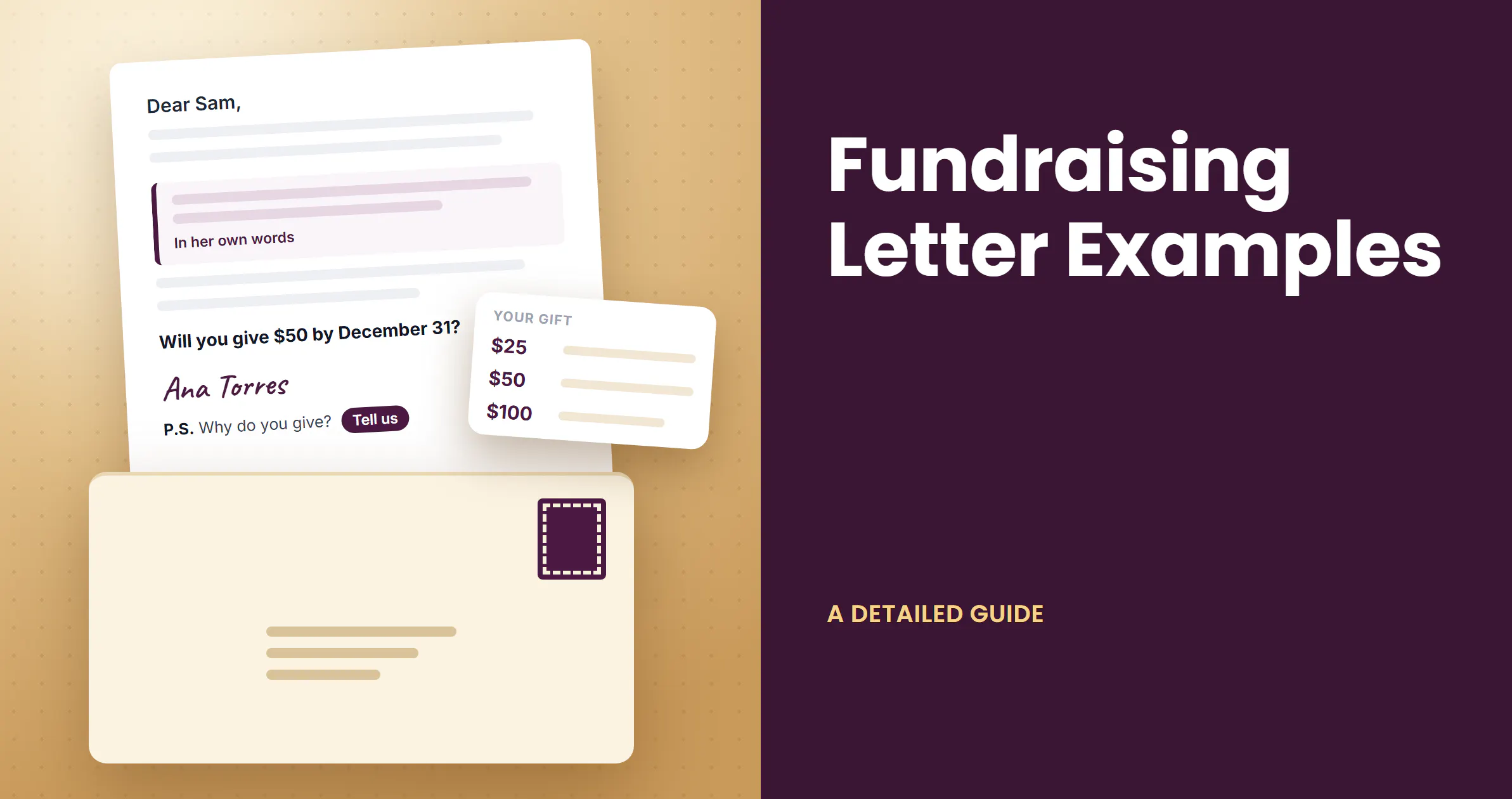
"Will you give $50 by December 31?" is an ask. "Please consider a gift" isn't.
Add a short gift ladder like Catholic Charities did, with 3 to 5 amounts and what each one buys.
If you know someone's last gift, ask for a little more than that.
5. Give a real deadline.
December 31 is the deadline that counts at year-end. Gifts made online or postmarked by then count for this tax year.
A matching gift makes the deadline stronger. Name the matching donor, the cap and the date.
6. Sign it from one real person.
Pick one person your donors know by name. That could be your executive director, your board chair or the program lead who knows the story best.
On printed letters, a short handwritten note next to the signature helps.
7. Repeat the ask in the P.S.
Many readers look at the signature and the P.S. before they read the letter. Direct-mail researcher Siegfried Vögele found this in eye-tracking tests, as Chorus America explains.
So the P.S. should repeat the ask and the deadline in one line. Then it can do one more job. There are 5 P.S. lines to copy below.
How long should the whole letter be? One page for most letters, and 2 when the story earns it.
Here's a year-end appeal letter template you can copy.
This fundraising letter template has a slot for a real person's words instead of "[insert story]." Fill every bracket with something true.
Dear [First name], In [month], [Name] [one moment from their story, in one sentence]. "[Their own words. 1 or 2 lines, used with their permission.]" That moment happened because of people like you. This year your gifts [1 or 2 results people can picture]. But [what's still needed, with a number, like a waiting list or empty seats]. Will you give $[amount] by December 31? $[amount] [what it buys, in one line]. $25 [what it buys] $50 [what it buys] $100 [what it buys] $250 [what it buys] You can give at [short web address], with the QR code below, or with the envelope inside. Thank you for standing with [Name] and everyone like them. [Signature] [Full name], [Title] P.S. [Repeat the ask and the December 31 deadline in one sentence.] And if you'd tell us why you give, we'd love to hear it: [story link]
Here's the email version. Send it the day the printed letter lands.
Subject: [Name] wanted you to hear this Hi [First name], [Name] [one moment from their story, in one sentence]. "[Their own words, 1 line.]" Your gifts made that possible this year. But [what's still needed, with a number]. Will you give $[amount] before December 31? It [what it buys]. [Button: Give $[amount] now] Thank you, [Full name], [Title] P.S. Why do you give to [Organization]? Tell us in 2 lines or a 30-second video: [story link]
3 more subject lines that work for it:
- What your gift did this year
- [Name]'s first winter indoors
- 3 days left to give in 2026
And 5 P.S. lines for 5 different jobs:
Deadline: P.S. Gifts made online or postmarked by December 31 count for this tax year. Match: P.S. [Donor name] will match every gift up to $[cap] until December 31. Your $50 becomes $100. New for 2026: P.S. Even if you don't itemize, you may be able to deduct up to $1,000 of cash gifts this year ($2,000 if filing jointly). Monthly: P.S. Would a small monthly gift be easier? $10 a month [what it buys]: [link] Story: P.S. Why do you give to [Organization]? Tell us in 2 lines or a 30-second video: [story link]. We'll only share it with your OK.
If the story slot is still empty, keep reading. The last 2 sections show you where the story comes from.
Mail your year-end appeal letter by November 13, then follow up 3 times.
Year-end giving runs on 3 dates this year. Thanksgiving is November 26, Giving Tuesday is December 1 and the tax year ends on December 31.
Your letter should land the week before Thanksgiving.
If you're also planning Giving Tuesday ideas, use the same story in both. Donors who see one person twice remember them.
Here's a simple year-end appeal schedule for a team of 2.
| When | What to send | Who gets it |
|---|---|---|
By Nov 13 | Mail the letter | Your whole mailing list |
The day it lands | The email version | Everyone with an email |
Dec 1 | A Giving Tuesday email | Everyone who hasn't given |
Dec 15 | A short story update | Everyone who hasn't given |
Dec 29–31 | Last call before Dec 31 | Everyone who hasn't given |
Within 2 days of a gift | A thank-you | Every donor |
January | What their gift did, plus the story ask | Every year-end donor |
Send the reminder emails only to people who haven't given yet. Nothing annoys a new donor faster than "Did you forget?" the day after they gave.
New for 2026: donors who don't itemize can deduct cash gifts.
This is worth one line in every year-end appeal. Starting with the 2026 tax year, people who take the standard deduction can deduct up to $1,000 of cash gifts.
Married couples filing jointly can deduct up to $2,000. That's from IRS Topic 506.
Gifts to donor-advised funds don't qualify, and neither do noncash gifts like stock, the IRS notes.
Most small donors don't itemize. So this may be the first year a gift to you lowers their tax bill.
Say it in one plain line. Then point donors to the IRS or their tax advisor for the details.
Send each donor the story from the program they fund.
One letter for everyone is fine if you run one program. Most nonprofits and associations run several.
A donor who funds your after-school program wants the after-school story. A member who gives to your scholarship fund wants to hear from a scholar.
Here's how the letter changes by group:
- Program donors get the story from that program.
- Members get a story from a fellow member, plus the program their gift pays for.
- Lapsed donors get "here's what happened since your last gift" and a smaller ask.
- Monthly donors get a thank-you and a story, with an upgrade ask or no ask at all.
- First-time donors get a story from the program they gave to last year.
- Major donors get a personal note or a phone call before the letter arrives.
5 versions of the letter need 5 stories. That's where most teams get stuck in November.
The fix is to collect impact stories all year and file them by program. Then writing 5 versions is an afternoon of picking instead of a week of chasing.

In Famewall every story lands in one Testimonial Organizer. You can tag it by program, search for it and move it to that program's wall.
So when the year-end letter comes around, you open the program's wall and pick the strongest story.
Use the P.S. to ask donors why they give.
Your year-end donors are next year's storytellers. So are your members and volunteers, but most letters never ask them.
The Fundraising Effectiveness Project calls turning a first gift into a second "the most consequential unsolved problem" in fundraising.
A P.S. that asks for a story gives new donors a way to stay involved that isn't another gift.
Here's how to set it up:
- Make one story page with 2 questions. "Why do you give to [Organization]?" and "What would you tell a friend who's thinking about giving?"
- Let people answer in a couple of lines, or record a 30-second video or audio clip.
- Add a consent checkbox and ask how they'd like to be named.
- Put the link in the P.S. On printed letters, add a free QR code of the link next to the reply slip.
- Thank each person who answers within a week.

AAHA, the American Animal Hospital Association, runs a story page like this for its accreditation program. Members answer 3 questions in text or on video, and their stories show up on a wall on the same page.
One page can collect a lot. CIPR collected 175 written stories and 25 videos in 2 weeks from one.
Here's what happens to the answers.

The best stories go on a wall of supporter stories next to your donate button. People read why others give right before they decide.
The rest go into thank-you letters, the January impact update and next year's appeal.
On Famewall you can add a field like "Which program do you support?" so each answer lands with the right program. The consent message on the page is yours to write.
Next November, the blank under "Dear [First Name]" is already filled.
Fundraising letter FAQs
How long should a fundraising letter be?
Most fundraising letters fit on one page, which is about 300 to 500 words. Go to 2 pages only when the story needs the room, like Catholic Charities did with Nick's story.
When should you send a year-end appeal letter?
Mail it by mid-November so it lands before Thanksgiving and Giving Tuesday. Then email people who haven't given on Giving Tuesday, in mid-December and in the last 3 days of the year.
What is the difference between an annual appeal and a year-end appeal?
An annual appeal is your once-a-year ask to your whole list. A year-end appeal is any appeal sent in November and December, before the December 31 tax deadline. Most nonprofits send their annual appeal at year-end, so the two are usually the same letter.
What should the P.S. say in a fundraising letter?
The P.S. should repeat the ask and the deadline in one sentence, because many readers look at it first. Then it can do one more job, like a matching gift, monthly giving or a link that asks donors why they give.
Have a real story ready for every program
Famewall gives each program its own story page for text, video and audio, with your consent message on every story. Put the link in your P.S. and approved stories go live on a wall you embed on your own website, without a developer.