Testimonial request templates without feeling awkward

Testimonial Request templates for every situation - Emails, video scripts, forms, and follow-ups.

Each one tells you when to send it, what to write, and why it works.

Here are 15 testimonial request templates ready to copy and send to your customers

100% free · No credit card · Works for any business
Quick Copy Templates

4 Testimonial request templates that cover most situations

Pick the one that matches the moment, hit Copy, paste into your email client, swap the brackets, and send.

Every [Testimonial link] below is your Famewall collection link. Grab one free →

Everyone

Simple Ask

Best for
All businesses and all niches. The default starting point.
When to send
Within 48 hours of a positive interaction, completed delivery, or milestone.
The email
SubjectCan I share your experience?
Hi [First Name],

I saw that [specific outcome, e.g., "your project wrapped up," "you hit your first 100 sales," "you've been with us for six months"]. That's really exciting.

I'm putting together a page for people who are considering [Product/Service Name] and I'd love to show what customers actually experience. Would you be willing to leave a short testimonial?

[Your testimonial link]

2 or 3 sentences is all it takes.

Thanks,
[Your Name]
Why it works

The opening line references something specific to their situation, so it doesn't read as a mass email. One clear link removes friction. And "2 or 3 sentences" tells them exactly how much effort this involves before they even click.
Agency

Post-Project

Best for
Agencies, freelancers, consultants after a project completes.
When to send
Within 24-48 hours of finishing, while it's still fresh.
The email
SubjectWorking with you was a pleasure, one small ask
Hi [First Name],

I'm happy to let you know that [Project Name] is officially done. [add one specific personal note about the project or client].

Before we close things out, would you be willing to share a few words about working together? 

It helps potential clients understand what the process actually looks like.

[Testimonial link]

Best,
[Your Name]
Why it works

Sending while the project is still fresh gets you the most detailed responses. The personal note shows this isn't automated. And pointing toward the "process" angle gives them something concrete to write about instead of a blank page.

Video

Video Request

Best for
Any business with an established customer relationship.
When to send
After a visible result, milestone, or strong positive interaction.
The email
Subject3 questions, 3 minutes. Would you be up for this?
Hi [First Name],

I have a small request. Would you be willing to answer 3 short questions on video?

Just 3 questions on your phone or laptop:

1. What problem were you trying to solve before you found us?
2. What changed after you started using [Product/Service]?
3. Who would you recommend this to?

No preparation needed. Click the link, answer in your own words, done in about 3 minutes.

[Video testimonial link]

If you'd rather write something, that works just as well: [Written testimonial link]

Thanks,
[Your Name]
Why it works

Framing it as "3 questions" removes the intimidation of "recording a testimonial." Customers know exactly what they're agreeing to before they click. Giving a written fallback means more people complete something even if video feels like too much.

Reply

Permission-to-Use

Best for
Responding to unsolicited praise (a positive email, DM, or review).
When to send
Within hours of receiving the compliment.
The email
SubjectCan I share what you said?
Hi [First Name],

What you wrote genuinely made my day. Thank you.

I'd love to share your words on [our website / social media / marketing materials]. Would that be okay?

I'd only include your name, photo, or company if you're comfortable with that.

Just reply with a yes and I'll take care of the rest. And if you'd rather keep it private, I completely understand.

[Your Name]
Why it works

This turns organic praise into owned social proof with one short email. Asking first builds trust. The explicit opt-out language shows you're not pressuring them, which usually makes them more likely to say yes.

Subject Lines

50 testimonial request subject lines

The subject line decides whether the email gets opened. Skim the bank, copy what fits the moment, paste into your email client. Filter by category to narrow it down.

These subject lines work alongside the full testimonial request templates above. Pair a quick subject line with the body of any template that fits the moment.

By Situation

15 testimonial request templates for the moments you'll actually face

Filter by your business type or scenario. From a first-time ask to a Google review request to the thank-you after submission.

General

Simple Ask

Best for
Any business, first outreach to any happy customer.
When to send
Any time after a clearly positive interaction.
The email
SubjectA quick favor
Hi [First Name],

I'm hoping I can ask a small favor.

We're always looking to show potential customers what our [Product/Service] is like from someone who's actually used it. 

Would you be willing to share a sentence or two about your experience?

[Testimonial link]

Takes about 2 minutes.

Thanks so much,
[Your Name]
Why it works

Clean and direct with no filler. Good when you don't have a specific milestone to reference.

Reply

After a Happy Customer Message

Best for
Responding to a positive email, DM, or support interaction.
When to send
Within a few hours of receiving the positive feedback. Strike while the sentiment is high.
The email
SubjectSo glad to hear that. One more thing
Hi [First Name],

Thank you for the kind words. It means a lot.

One small ask: would you be open to sharing what you told me on our testimonials page? 

It would really help other [coaches / founders / business owners] who are still deciding.

You can paste it directly here, or rewrite it however you'd like:

[Testimonial link]

No pressure at all either way.

[Your Name]
Why it works

Giving them the option to paste what they already wrote lowers the effort to near zero. They don't have to think of something new. They already said it.

Agency

After Project Completion

Best for
Agencies, consultants, freelancers.
When to send
Within 48 hours of finishing a project or engagement.
The email
Subject[Project Name] is done, and one small ask
Hi [First Name],

[Project Name] is officially wrapped. I'm really happy with how it came together, and I appreciate you trusting us with it.

One ask: would you be willing to leave a short testimonial about working with us? Anything about [the result / the communication / what the process was like] would be incredibly useful for people who are deciding whether to hire us.

[Testimonial link]

Two or three sentences is perfect.

[Your Name]
Why it works

Pointing them toward specific topics (result, communication, process) gives them something easy to write about instead of a blank form.

SaaS

SaaS Customer

Best for
Software companies, SaaS products.
When to send
After a product milestone (first major feature use, 30-day mark, or first meaningful result).
The email
SubjectNoticed you hit [milestone], quick ask
Hi [First Name],

I saw that you recently [hit your first 100 testimonials / published your Wall of Love / completed your first automated campaign]. That's a meaningful step.

I'm reaching out because I'd love to include your story on our testimonials page. Even a sentence about what you were trying to solve before, and what's different now, would be genuinely useful.

[Testimonial link]

Takes about 2 minutes. And if it's not the right time, no worries at all.

[Your Name]
[Company Name]
Why it works

Triggered by a real in-product event, so it doesn't feel random. The before-and-after frame gives customers a clear story structure. You give control over to customers.

Agency

Agency / Client

Best for
Marketing agencies, design studios, growth consultancies.
When to send
At a quarterly review, after hitting a major KPI, or at contract renewal.
The email
SubjectQuick question about our work together
Hi [First Name],

We've been working together for [time period], and I wanted to check in and ask for a small favor.

Would you be open to sharing a short testimonial about what it's been like working with [Agency Name]? It would really help us when potential clients ask for references.

Even a sentence about [the result you achieved together / what changed for their business / how the collaboration worked] is enough.

[Testimonial link]

If there's ever a better time to ask, just let me know.

[Your Name]
Why it works

Framing it as "checking in" softens the ask. And "is there a better time" gives them an easy out, which often makes them just do it now.

Coach

Coach / Consultant

Best for
Business coaches, life coaches, consultants.
When to send
After a transformation moment, completion of a package, or when a client shares a win.
The email
SubjectYour win from last week
Hi [First Name],

What you shared in our last session really stayed with me. [reference the specific breakthrough or result].

That's exactly the kind of progress I hoped we'd get to. 

And it's the kind of story that helps other [entrepreneurs / professionals / leaders] know that what they're struggling with is solvable.

Would you be open to sharing a few words about your journey: where you started and where you are now?

[Testimonial link]

Just your honest experience.

[Your Name]
Why it works

Personal, specific, and tied to their own result. The most converting coaching testimonials are transformation stories. This template nudges toward that without boxing them in.

Ecommerce

Ecommerce Customer

Best for
Online stores, DTC brands, physical products.
When to send
7–14 days after delivery, after they've had time to actually use the product.
The email
SubjectHow's [Product Name] treating you?
Hi [First Name],

Your order from [Store Name] should have arrived a couple of weeks ago. Hoping it's been exactly what you needed.

If you've had a chance to try it out, I'd love to know what you think. And if you're happy to, a short testimonial would mean a lot to us.

[Review or testimonial link]

2 minutes, and it genuinely helps other customers decide.

Thanks,
[Your Name]
[Store Name]
Why it works

The conversational check-in opener is disarming. Timing it right (not day one, not two months later) captures genuine first impressions before the novelty fades.

Course

Course Creator

Best for
Online course creators, cohort programs, workshops.
When to send
After a course completes, at a midpoint milestone, or when a student shares a win.
The email
SubjectYou just finished [Course Name]. What was it like?
Hi [First Name],

You made it through [Course Name]. That's a big achievement. Most people who enroll don't finish.

I'm curious what the experience was actually like for you, especially [one specific thing, e.g., "the framework in module 4" / "the live sessions" / "the result you got"].

If you'd be open to sharing a few words, it would really help me reach students who are in the exact position you were in at the start.

[Testimonial link]

No template or format required.

Thanks,
[Your Name]
Why it works

Acknowledging they finished (and that most don't) makes them feel seen. The specific question gives direction without boxing them in.

Nonprofit

Nonprofit Donor / Volunteer

Best for
Nonprofits, charities, community organizations.
When to send
After a successful campaign, event, or volunteer experience.
The email
SubjectYour impact this year
Hi [First Name],

Because of people like you, [specific outcome, e.g., "we distributed 2,000 meals this month" / "we helped 47 families find stable housing this year"].

I'm putting together testimonials from our donors and volunteers to share on our site and in our annual report. Would you be willing to share what brought you to [Organization Name] and what keeps you involved?

[Testimonial link]

Even a sentence or two is meaningful.

Thank you,
[Your Name]
[Organization Name]
Why it works

Leading with concrete numbers reminds them why they give. Nonprofit testimonials should feel like shared mission, not a marketing ask. This template gets that tone right.

General

Long-Time Customer

Best for
Any business with loyal, long-term customers.
When to send
At an anniversary, renewal, or multi-year milestone.
The email
SubjectA year ago you started using [Product/Service]
Hi [First Name],

It's been [one year / two years / three years] since you first signed up with [Company Name].

Long-term customers like you have a perspective that's genuinely different from someone who's been with us three weeks. You've seen what the product is like over time.

Would you be open to sharing a few words about your experience? 

Specifically, what keeps you coming back, or what's changed over the years?

[Testimonial link]

No pressure, completely optional. But if you do, I'll make sure to thank you.

[Your Name]
Why it works

Acknowledging the anniversary signals you track and value the relationship. Asking for the "over time" angle produces testimonials that speak to durability and sustained value. A different and often more convincing story than a first-impression review.

Video

Video Testimonial

Best for
Any business with established relationships and visible results to showcase.
When to send
After a strong result, positive message, or major milestone.
The email
Subject3 questions, 3 minutes on video
Hi [First Name],

I'd love it if you were willing to record a short video about your experience with [Product/Service].

I'm not asking for a polished production. Just your phone or laptop, and answers to three simple questions:

1. What were you trying to solve when you came to us?
2. What's been the biggest change since you started using [Product/Service]?
3. Who would you recommend this to?

You can record directly here. No account, no software, no file uploads:

[Famewall video testimonial link]

Takes about 3 minutes. And if video feels like too much, a written testimonial works just as well:

[Written testimonial link]

[Your Name]
Why it works

2 options mean fewer people say no entirely. The 3 questions do double duty: they reduce friction AND structure the testimonial around the most persuasive story. Video builds trust in a way text alone can't.

Local

Google Review + Testimonial

Best for
Local businesses, service businesses, anyone who wants both Google visibility and website social proof.
When to send
After a completed service or positive interaction.
The email
SubjectTwo quick favors, if you're willing
Hi [First Name],

I have two small asks, and either one is helpful, so no pressure to do both.

If you've had a good experience with us:

1. A Google review would really help people find us: [Google review link]
2. A more detailed testimonial on our website: [Testimonial link]

Both take about 2 minutes. Either one is genuinely appreciated.

Thanks,
[Your Name]
Why it works

Google reviews help with local search visibility. Website testimonials give you full control over display and context. Getting both is ideal. Framing them as "either one is helpful" reduces the pressure enough that most customers do at least one.

Reply

Social Media

Best for
Any business when a customer posts publicly about you or tags you.
When to send
Within hours of the post going live.
The email
SubjectLove what you posted. Can I use it?
Hi [First Name],

Just saw your post about [your product/service name] and it genuinely made my day. Thank you for that.

I'd love to share it on [our website / Instagram / LinkedIn] if you're okay with it. I'd credit you fully, of course.

If yes, just reply and I'll take care of the rest. And if you'd rather I didn't, no worries at all.

[Your Name]
Why it works

Social proof that already exists is the easiest testimonial to collect. This testimonial request template converts earned social content into owned testimonial content with one permission request and 30 seconds of your time.

General

Follow-Up

Best for
Anyone who hasn't responded to the initial request.
When to send
3–5 days after the first email. Once, not twice.
The email
SubjectRe: [Original Subject Line]
Hi [First Name],

Just following up on my note from last week about leaving a testimonial. No pressure if you haven't had a chance. I know things get busy.

If you're open to it, the link is still here:

[Testimonial link]

If now isn't the right time, totally understand. I'll leave it here in case you want to come back to it.

[Your Name]
Why it works

One gentle follow-up roughly doubles your response rate without damaging the relationship. The key is soft language and making it easy to close the loop without feeling guilty.

General

Thank-You and Approval

Best for
After a customer submits a testimonial.
When to send
Within 24 hours of receiving the submission.
The email
SubjectGot your testimonial. Thank you
Hi [First Name],

I just received your testimonial and wanted to say thank you personally. It means a lot.

Before I publish it, I want to confirm a few things:

- Publish it on our website: Yes / No
- Use your name: First name only / Full name / Keep anonymous
- Include your photo: Yes / No
- Include your company or title: Yes / No

Just reply with your preferences and I'll handle the rest. If you already gave consent through the form, consider this a confirmation.

Thanks again,
[Your Name]
Why it works

Always confirm consent before publishing. This protects you legally and shows customers you respect their privacy. Customers who see you handle it this way trust you more, not less.

By Channel

Scripts for every channel, not just email

Email is the default, but some of the best testimonial moments happen in DMs, on the phone, or in person. Each script below is tuned to its medium: tone, length, and timing.

LinkedIn DM

Best for

B2B clients, agencies, consultants, anyone with a LinkedIn-first relationship.

Hi [First Name], thanks again for [specific moment from the project]. 
    
Would you be open to sharing a few words about working together? Even one or two sentences helps people who are deciding whether to hire us.

[Testimonial link]

No pressure if it's not the right time.
Lead with the working relationship. Keep it short, professional, no emojis.

Instagram / X DM

Best for

Creators, ecommerce customers, niche communities, anyone already engaging on social.

Hey [First Name]! Quick one. Would you be cool with sharing a few words about [Product]? Even just a sentence would help us a ton.

[Testimonial link]
Casual tone. One emoji at most. Keep it under three lines.

SMS / WhatsApp

Best for

Service businesses, local shops, anyone who texts with customers.

Hey [First Name], it's [Your Name] from [Company]. 
    
Could I get a quick testimonial when you have a sec? Even one line helps.

[Testimonial link]
Identify yourself first. Keep it under 160 characters. One link, no formatting.

In-person ask

Best for

Coffee meetings, conferences, store visits, retail, in-clinic.

Thanks again for trusting us with [project]. We're putting together a page for other [niche] who are deciding.
    
Would you be open to sharing a quick line about your experience? I can send you a link to type it, or you can tell me now and I'll write it down.
Spoken script. Maintain eye contact. Have your link ready to share on the spot.

Phone call

Best for

High-touch service businesses, agencies, consultants, B2B sales follow-ups.

"Hey [First Name], I wanted to thank you for [reason] and ask a quick favor. 
    
Would you be willing to leave a short testimonial about [your experience]? I'll email you the link, takes about 2 minutes. Just a sentence or two about what working with us was like."
Open with the reason for the call. Confirm timing before asking.

Slack / community

Best for

SaaS communities, Discord servers, Circle/Mighty Networks groups, customer Slack channels.

Hey [First Name] 👋
    
Quick ask - would you be open to sharing a quick testimonial about [Product]? Takes 2 mins:

[Testimonial link]

Means a lot 🙏
Use a thread, not the main channel. Match the community's usual tone.

Post-purchase message

Best for

Ecommerce, SaaS onboarding, any product with a clear first-use moment.

Hi [First Name], 
    
Thanks for choosing [Product]. Once you've had a chance to use it, we'd love to hear what you think.

Drop a quick testimonial here whenever you're ready: [Testimonial link]

No rush. Even a sentence helps a lot.
Send after they've actually used the product, not immediately after purchase.
Form Template

A hosted testimonial request template form removes the back-and-forth entirely

Email gets you started. A dedicated collection page closes the loop. The form below is a real Famewall collection page. Scroll through it, try the fields, see what your customers would see.

Live formreal Famewall collection page below
Make this exact form yours
use it live
Make this form yours in minutes

Same fields. Same questions. Branded with your colors. No coding, no embeds, no hand-built forms.

Use this form template

What customers send back when you ask

Real testimonials collected through Famewall — by founders, creators, and businesses using templates like the ones above.
Video Testimonial

Don't ask for a video. Ask 3 questions.

Video testimonials build trust immediately. The reason most businesses can't collect them: they make it too complicated. The fix is simple: stop asking for a 'testimonial' and start asking for three answers.

the 3 questions
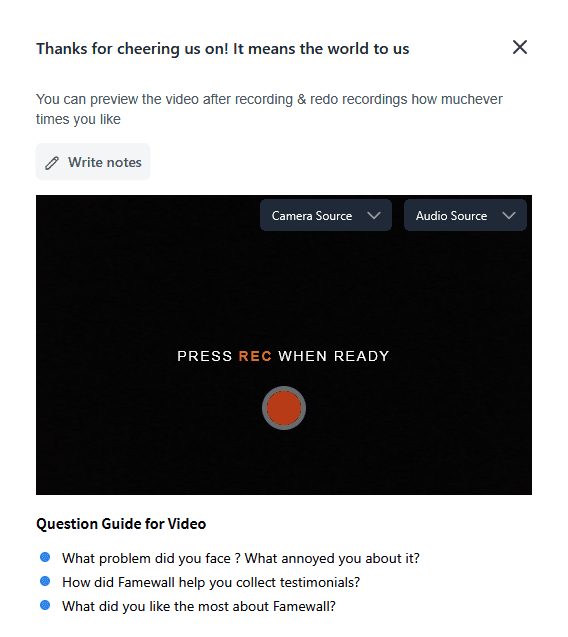
What customers see when they click your link
Famewall video testimonial collector with question guide below the recorder
30-second customer script

“Before [Product/Service], I was struggling with ___. Since I started using it, ___. I'd recommend this to anyone who ___.”

Under 60 seconds. Beats a 5-minute polished video.
tips to reduce friction
No app downloads

The best video tools record directly in the browser. Requiring a download loses most people before they start.

Send at the right moment

A cold video request is hard. A request right after someone shares a visible win is much easier.

Show questions upfront

Customers who can read the questions before recording come more prepared. Response quality goes way up.

Let them re-record

If the first take is rough, they should be able to try again without emailing you. Handle this on the collection page.

1
Email link
2
Questions
3
Record
Video testimonial flow
Replace with a real Famewall screenshot

See how Famewall handles video testimonial collection, or compare video testimonial tools side by side.

Timing

When to ask, and when to wait

The testimonial request template matters. The timing matters just as much. The right moment is when the customer has experienced a clear win and it's still fresh.

Dobest moments
  • After a successful project

    The single best moment for agencies and freelancers. The result is clear, the relationship is warm, and they have something concrete to write about.

  • After a customer compliments you

    Someone sends a positive email or DM. That's the moment. Strike while the sentiment is high. Ask if you can share what they said, or send them directly to your collection page.

  • After onboarding success

    A customer just hit their first milestone in your product. Their first win. That's when to ask, not before.

  • After a measurable result

    They hit 100 reviews, doubled their conversion rate, sold out their first cohort. A specific result makes for a specific testimonial.

  • After renewal

    A customer just renewed their contract or subscription. They voted with their wallet. Ask them to say it in words.

  • After a support win

    Your team solved a real problem for them. That can be even more powerful than product praise. It shows you care after the sale.

  • After a repeat purchase

    An ecommerce repeat buyer is a converted skeptic. Their testimonial carries real weight precisely because they chose you twice.

Don'twhen not to ask
  • Before they've seen value

    Asking a new customer what they think on day 3 puts them in an awkward position. They don't have an opinion yet, and being pushed to form one isn't a great experience.

  • Right after a complaint

    Even if the support interaction went well, the timing is wrong. Wait until the positive resolution has had time to become prominent in their mind.

  • During a stressful or busy period

    If your customer just went through a rough quarter, a testimonial request is bad. Hold off and find a better moment.

Writing Rules

7 rules that double your testimonial response rate

You can copy a template word for word and still get a low response rate if you ignore these. Each comes from what actually gets replies vs. what gets ignored.

01

Keep it short

Your testimonial request should take 30 seconds to read. If it's longer than 5 short paragraphs, cut it down.

02

Mention something specific

Generic requests get ignored. A specific reference like "you hit your 50th testimonial last week" connects with the reader's and makes them feel seen.

03

Ask from a real person

Emails from a named person ("Alex at Famewall") outperform "The Team at Company X" by a wide margin. Customers reply to humans, not brands.

04

Use 1–3 guided questions

A blank testimonial form is intimidating. 3 specific questions give customers structure. The quality of what you get back is better.

05

Give them one clear link

Don't write a paragraph with multiple options and 3 different URLs. One link. One next step.

06

Offer text and video options

Some customers will write. Some will talk. Giving them both options meaningfully increases the number who complete something.

07

Follow up once

A single gentle follow-up 3–5 days after the original request is fine. More than once puts pressure on the customer.

Follow-Up Sequence

Most testimonials come from follow-ups, not first asks

The trick is being polite and giving people an obvious out. A short sequence that gets results without crossing into pressure.

1
Day 0

Initial Ask

Send your main template based on the situation. Keep it short, specific, and end with one clear link.

2
Day 3–5

Gentle Reminder

A short "just in case it got buried" note. One link. Keep it under 3 sentences.

3
Day 7–10

Final Follow-Up (optional)

Tell them it's the last one. Thank them for being a customer regardless.

Follow-up

Gentle Reminder (Day 3–5)

Best for
Sent after the initial template if you haven't heard back.
When to send
3–5 days after Email 1. Once only.
The email
SubjectRe: [Original subject line]
Hi [First Name],

Following up on my note from earlier this week, just in case it got buried.

[Testimonial link]

No pressure at all if it's not the right time. Just wanted to make sure you saw it.

[Your Name]
Why it works

One soft reminder roughly doubles your response rate without damaging the relationship.

Follow-up

Final Follow-Up (Day 7–10)

Best for
Optional last message before you stop following up.
When to send
7–10 days after Email 1. Optional. Move on after this.
The email
SubjectLast note on this
Hi [First Name],

I'll keep this short. This is my last message about the testimonial. No pressure at all.

If you'd like to, the link is still here: [Testimonial link]

Either way, I appreciate you being a customer.

[Your Name]
Why it works

Telling them this is the last one removes anxiety about ignoring more messages.

!
Two follow-ups is the maximum. If someone hasn't responded after three messages, move on. Better to find the next happy customer moment and start fresh.
Collection Workflow

The end-to-end loop with testimonial requests, without the back-and-forth

Testimonial request templates get you better responses. Managing the emails, follow-ups, submissions, approvals, and display manually is a lot. Here's the workflow that removes all of it.

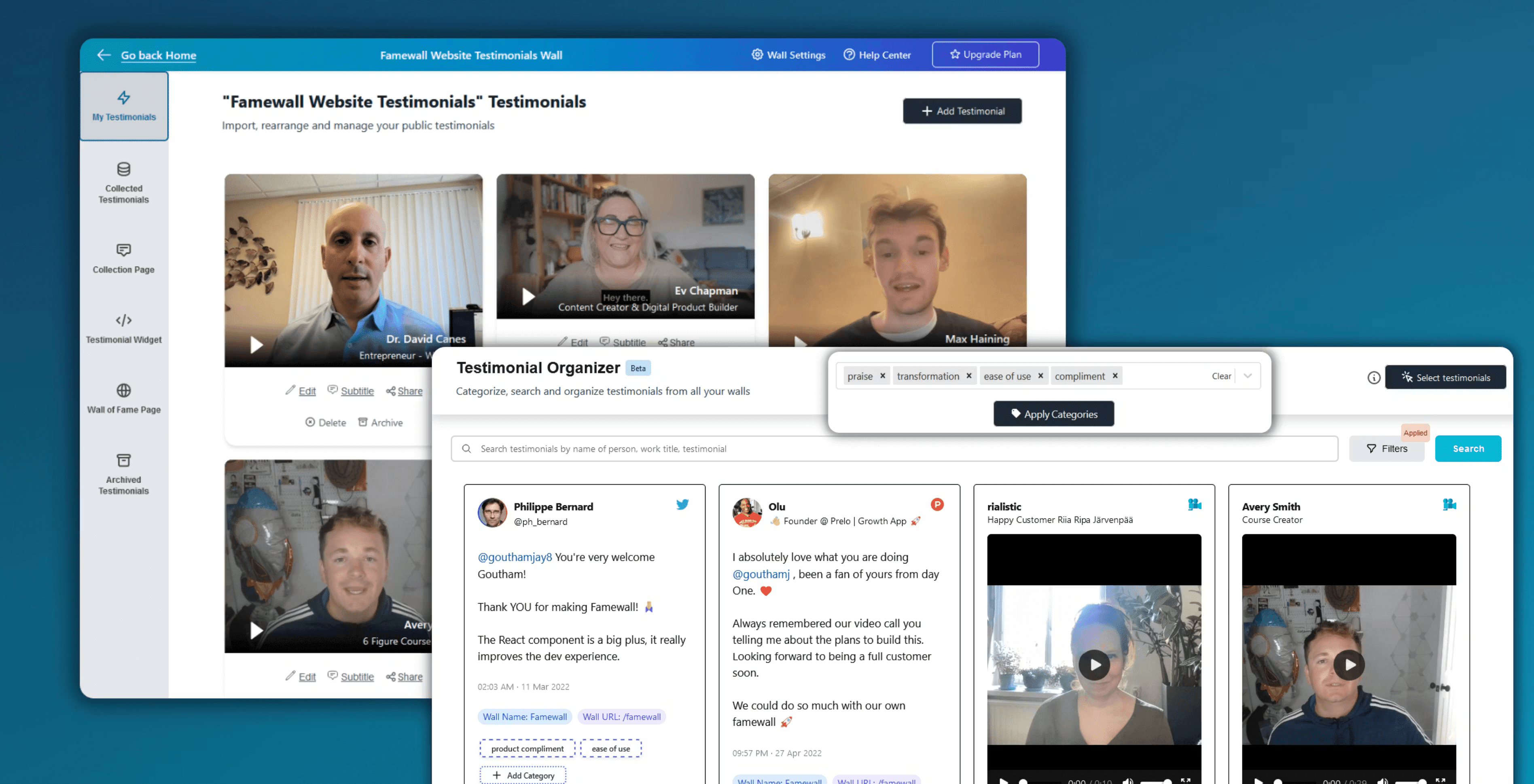
Famewall testimonial collection dashboard showing the end-to-end workflow
step 01

Create a collection page

One URL with your custom questions, your branding, and options for text or video. No blank box, no format confusion.

step 02

Add custom questions

Guide customers toward the story that converts: the problem they had, what changed, the specific result.

step 03

Share one link

Send it in your email template. Add it to your signature. Drop it in your post-project wrap-up.

step 04

Collect text + video

Customers write or record from their phone or laptop. No account, no uploads, no coordination needed.

step 05

Review and approve

See all submissions before anything goes live. Approve what fits, skip what doesn't.

step 06

Display on your site

Paste a snippet once. Your wall updates automatically every time you approve a new submission.

Want to see this in practice across industries? The testimonial examples page shows the collection page and final display side by side. Already collecting? The management dashboard handles approval. Need help shaping your questions? The questions generator builds a custom set for your business.

Free Template Pack

Take all 15 templates with you

Every template above is free to copy. If you'd prefer the whole pack as a portable file, pick a format. No email required, no signup wall.

format 01

PDF

All 15 templates, formatted and ready to share.

format 02

Word

Drop into your brand templates and tweak.

FAQs

Frequently asked questions

Short, honest answers to what comes up most often.

Ask in a short, personal email right after they've seen a positive result or finished a project with you. Reference something specific to their situation, include a direct link to your testimonial form or collection page, and make clear that 2 or 3 sentences is enough.
A good testimonial request email acknowledges the specific positive outcome or milestone, asks directly for a testimonial, explains why you're asking (it helps other customers decide). It gives them one clear link to submit, and keeps the whole message short.
The best moments: right after a project completes, when a customer shares a positive result or sends you a compliment, after a renewal, after a customer's first major product milestone, or after a repeat purchase. The window is usually 24-48 hours after the positive moment.
Frame it around three specific questions rather than asking them to "record a testimonial." Tell them exactly how long it will take (usually about 3 minutes). Send a link that lets them record directly in their browser, with no software download or file upload required.
Once is enough for most situations. Two follow-ups maximum: one at 3–5 days, one at 7–10 days. After that, move on. Continuing to follow up past two messages damages the relationship and is unlikely to get you a response.
The most effective forms ask: what problem were you trying to solve before you found us, what changed after you started using our product or service, what specific result have you seen, and who would you recommend this to.

Stop paying for expensive tools & start collecting testimonials in a breeze