How to Collect Customer Feedback in 5 Steps (in 2026)

Collecting customer feedback is no longer optional. It’s essential.
Businesses that ignore feedback risk making decisions that hurt their return on investment (ROI), and they lose customers without knowing why.
On the other hand, companies that actively gather and implement feedback improve customer retention rates by 15% to 20%. Also, 72% of customers trust those companies.

This means those companies get repeat customers, stronger loyalty, and predictable revenue.
In other words, customer feedback influences your business growth.
But that’s not all.
Gathering customer feedback goes beyond good ROI. It also helps you know clients’ expectations, frustrations, needs, and even testimonials.
So, how do you go about this for the best results?
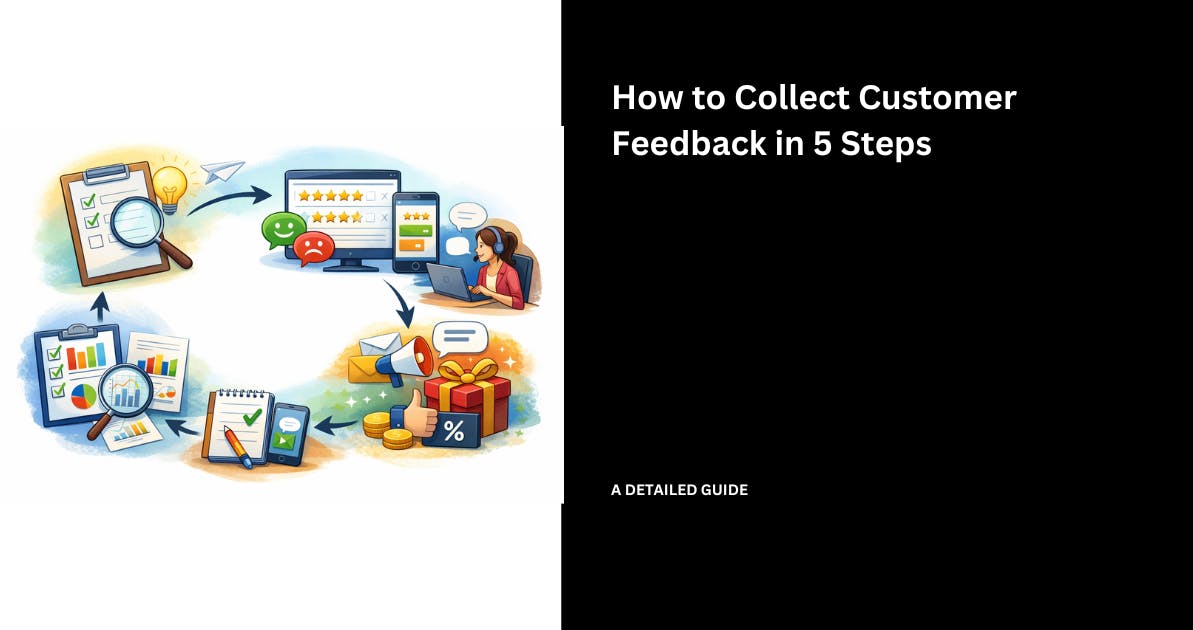
In this article, I’ll show you how to collect customer feedback effectively in five simple steps.
Then, I’ll share some practical examples to help you understand everything better.
How To Collect Customer Feedback
To collect customer feedback, you must:
Step 1: Identify the Right Customers to Ask
Step 2: Choose the Best Method and Tools for Collecting Feedback
Step 3: Ask Clear and Actionable Questions
Step 4: Offer Rewards in Exchange for Feedback
Step 5: Organize, Analyze, and Use the Feedback
Let me walk through each step more closely.
Step 1: Identify the Right Customers to Ask
You must collect customer feedback from the right clients. Asking the wrong ones means you’ll get generic and surface-level answers.
Your potential customers won’t be convinced by that kind of feedback. And that will most likely be bad for your business.
So you want to avoid people who will most likely give you vague or irrelevant feedback. These could be first-time visitors, free trial users, or giveaway participants.
Take this review on Google Maps, for example.

The reviewer gave 5 stars, but the actual feedback isn’t helpful to the company. You can use a word like “Amazing” to describe any company, service, or product.
This customer comes off as someone who isn’t willing to delve into details.
That may not provide value to potential customers. And it may also let them question the trustworthiness of the feedback.
Now, let’s consider this review from a Famewall client.

It’s detailed and specific. The customer describes a challenge he was facing and explains how their issue was resolved.
He clearly knows what he’s saying, which makes it much more believable.
Also, the feedback sounds like it’s coming from someone familiar with Famewall’s service.
This all means that the right customer (to offer genuine feedback) will be a frequent user or client. They will be someone who uses your product or benefits from your services a lot.

So they’ll be thorough about the feedback they offer.
You could also collect customer feedback from a recent or new user. Businesses do that all the time.

For example, after using the StyleSeat platform for a month, you will receive an email from them with the question: “How would you rate us?”

It isn’t text-based like we saw with the reviews on Google Maps and Famewall, but it still helps companies understand customer satisfaction.
Another way to collect customer feedback is to ask people who have stopped using your product. There may be a reason behind their decision, and that could help you improve.
An example is Apollo.io, which reaches out to users who haven’t used the platform in a while to collect feedback.

When you identify the right customers to ask, it becomes easier to frame your questions and collect feedback.
Step 2: Choose the Best Method and Tools for Collecting Feedback
After identifying the right customer, you must choose the best method and tools for gathering feedback.
There are many formats you can use to collect customer feedback:
- Text
- Surveys (In-app and email)
- Video
- Audio feedback
- Customer support
For text testimonials, collect your customers’ names, portraits, and actual feedback.

You could also collect star ratings, location, and before or after outcome.
Take it even further by collecting and adding featured badges like “verified customer,” “top reviewer,” or the customer’s job role.

Text testimonials are a traditional method of gathering customer feedback, but sometimes clients may want to say something quickly.
So you might want to have an audio testimonial collection option, too.
Though there are still other formats out there, the ones I mentioned above are proven to be the best.

Besides, audio testimonials have some advantages over text.
For example, customers can relate easily to a recording.
And that makes perfect sense because hearing a real voice feels more trustworthy than reading plain text.
Apart from the audio form, video testimonials are also believable since you can actually see the reviewer.

Pro Tip: Combine video testimonials with text to get the best results.
You can collect customer feedback in these forms (text, video, and audio) on websites, apps, via email surveys, or through customer support conversations.
Also, many tools such as Famewall, SurveyMonkey, Google Forms, Zendesk, and more can help with certain formats.
With Famewall, you can collect customer feedback in the form of text, video, and audio.

What’s even more interesting is that you can enable the AI composer to assist your customers in quickly writing their text.

You can find it in your testimonial collection page settings

You will give the page a title and enter the questions you want customers to answer.

Aside from text testimonials, you can also collect video testimonials.
You can provide the video page title and then a few question guide fields to guide customers through the video.

What’s more, Famewall lets your customers record audio testimonials too.
You only have to name the audio page title and add your question guide fields to guide them for the audio.

And without coding, you can select from Famewall’s list of free widgets to showcase your testimonials.

You can collect customer feedback from new clients.
Or from customers who are leaving and find out how they feel about your product.
Google Forms is ideal for gathering short surveys or internal feedback.

While Zendesk is great for customer support teams, it can collect customer feedback automatically after support interaction.
Here’s a table to really help you choose the best methods to gather customer feedback:
| Method | Who should use it? | Why it works? | Best time to use it |
|---|---|---|---|
Text Feedback (forms, widgets, simple input boxes) | Small business owners, entrepreneurs, and customer success teams | Easy to set up, low friction, great for quick thoughts, works on any device | When you want fast, lightweight feedback during onboarding, after feature use, or on your website |
Surveys | Product teams, UX teams, customer research teams | Provides structured and measurable data. It’s great for trends and works for large sample sizes | When you need quantitative data, Net Promoter Score (NPS), or structured insights |
Video Feedback | Course creators, coaches, wellness professionals | For more trust-building, showing emotion, and real user experience, great for testimonials | When collecting testimonials, case studies, or high-credibility social proof |
Audio Feedback | Coaches, customer success teams, and course creators | It’s easy for customers, and more emotional than text reviews, while faster than video testimonials. | When customers are on mobile or have limited time, but still want to share personal insights |
Customer Support Feedback | Customer support teams, SaaS platforms | Measures customer satisfaction after support interactions and reveals hidden issues | After closing support tickets or during follow-ups (to measure customer satisfaction) |
Step 3: Ask Clear and Actionable Questions
The next step to collect customer feedback is to ask clear and actionable questions.
The reason is that asking clear and actionable questions will help you collect answers you can truly use.
But if you ask unclear questions, you’re likely to receive vague answers like “it’s okay” or “I like it”.
Say you are a coach selling a digital product and want to collect customer feedback.
Asking a question like “How can we improve?” doesn’t give much direction.
This can leave your customers confused.

On the other hand, a question like “Was anything difficult or confusing during checkout?” is much clearer. The customer knows exactly what is expected of them.

By clear and actionable questions, I mean you should:
- Ask one question at a time
- Ask questions based on the customer’s experience: What did you like about our website? How easy was it to find what you were looking for on our website?
- Ask questions you can act on: What’s the one thing our website is missing? What can we do to improve your experience?
- Use simple language: Avoid jargon and statistical terms, and use plain, simple everyday words.
For example, “How likely are you to tell your friends about us?” not “Were your positive impressions of our service sufficient to justify a collegial recommendation?”
- Use clear rating scales: For example, 1 to 5, 1 to 10, or Poor or Excellent. On a scale of 1 to 10, how satisfied are you with our product (or service)?
When StyleSeat tries to collect customer feedback, they make the question very simple and clear:
- How likely are you to recommend us to a friend or colleague?
They also clearly define the beginning and end of the scale (from 0= not likely, to 10= very likely).

The point is to be as clear as possible when you want to collect customer feedback.
However, the next step is also as important as the one we are currently discussing.
Step 4: Offer Rewards in Exchange for Feedback
Your customers, even the happiest ones, can be busy. Time is a precious commodity, and surveys that last longer than 7-8 minutes experience high abandonment rates.

So, customers may not take the time to answer your survey or share their testimonials unless there’s something in it for them.
That’s why you offer rewards in exchange for feedback.
The rewards can be something symbolic as long as they motivate the customer to give feedback.
It could be a free product or service like what Starbucks offers in the Philippines. As a customer, you receive a tall beverage of your choice after providing your feedback.

The video company Game Nintendo offers loyalty points to customers after they participate in its surveys.

It could also be monetary. Teachable gives customers a chance to win a $50 gift card when they take a five-minute survey.

But you need to match the effort with the reward.
A survey that takes one minute is clearly different from one that takes 15 minutes.
The same goes for wanting to get video feedback from your customers
Because it takes time, and you want to motivate more clients in doing so, you need to include a reward.

The only thing is that you need to use tools that allow you to reward your customers in exchange for feedback.
You will be surprised that incentives like scratch card discounts can be highly effective.
That’s why Famewall lets you use scratch card discounts as rewards to collect customer feedback.

One thing is sure: If you motivate customers through rewards, you will never have to beg anyone for feedback.
Step 5: Organize, Analyze, and Use the Feedback
You were able to identify the right customers to ask, choose the best method and tools for collecting feedback, ask clear questions, and offer rewards in exchange for feedback.
Now, the final step is to organize, analyze, and use the feedback.
1. Organize
There are different formats and sources through which you can collect customer feedback: texts, surveys, videos, audios, or chat conversations.
You need to put everything in the right place so you don’t miss important insights.

You can, for example, group feedback by themes: customer, pricing, product features, or delivery.
If you use Slack, you can create a dedicated channel for customer feedback to organize discussions.

The organization process is so crucial that when well done, it makes the analysis easier.
And Famewall’s Testimonial Organizer feature can help you do this.
Just hit the “Select & move testimonials” to get started. You can also use the search bar and filter to find text, audio, and video testimonials that you’ve moved.

2 . Analysis
It’s one thing to collect customer feedback, and it’s another thing to analyze it.
It’s not about being overly excited with praises or feeling bad about complaints.
You may discover, for example, that 55% of your customers complain about the same feature of your product.
With such insights, you will definitely know where to focus.
Our Customer Pulse feature uses AI to help you analyze feedback.

All you have to do is select an analysis type. A few analysis types are:
- What customers like the most: So you can invest more in what’s working. Maybe you’ll double down on marketing and sales.
- Which pain points you helped them solve: So you can refine your selling points (value proposition) and improve on the features that matter the most.
- How customers describe you: This will help you discover the words your customers use to describe your product or service.
For example, maybe they say your service is reliable and trustworthy. You can then use these words in your website copy, ads, and messaging.
3 . Use feedback
Next, you use feedback to make changes or adjustments.
Avery Smith is one of the top Data Science instructors on Kajabi.

When I interviewed Avery, he told me that apart from social proof, he also uses feedback to help his students practice video mock interviews.

So he basically asks them questions through Famewall’s video testimonials feature.
Then he shares their answers with other students to foster learning and community building.
He’s actually using customer feedback to engage more with his students. To help them even more.
This also reminds me of how Starbucks implemented a two-click free WIFI in all its coffee shops after collecting customer feedback.

They did not just stop at collecting feedback. They acted upon it.
If you also want to go beyond gathering feedback, you can run an AI analysis and get specific recommendations for growth.

All you have to do is choose an analysis type.
You can find out what your customers like the most, the challenges your service or product helped them solve, and more.
By organizing, analyzing, and using the feedback, you are making sure your customers continue to like you and do business with you.
Collect Customer Feedback Easily
In this article, we discussed five steps to help you gather customer feedback easily.
You must identify the right customers, choose the best method and tools, ask clear and actionable questions, offer rewards, and organize, analyze, and use feedback.
Many tools, like Famewall, SurveyMonkey, Google Forms, or Zendesk, can help you take the above actions.
With everything I’ve shared, I believe you can now easily collect customer feedback!
Try Famewall for free to start collecting video testimonials from customers with a simple link & display them as social proof on your websites without writing any code